Better Dying Fund
Report on where philanthropy can change the system
Other formats
Executive Summary
The way we die in the UK has changed faster than the systems built to care for us. This report is the first stage of an effort to respond to that, by bringing together philanthropists who want to fund the changes the system needs but is currently not set up to deliver.
It sets out how we understand the system today, where we think change would matter most, and the kinds of funding that could support it. It is a starting position, not a finished plan. Over the coming months we will shape it with the practitioners, researchers, families and funders who know this field best, and this report is an invitation into that work.
Context: People are living longer and dying more slowly The historical end-of-life trajectory the modern hospice movement is built around - a relatively predictable decline over months due to cancer - is being displaced by dementia, frailty and multimorbidities, where the final phase can last years and it can be difficult to pinpoint when 'end-of-life' begins. Where we die is changing too: care homes already account for ⅕ of deaths and are on track to become the most common place of death in the UK by 2040. By that time, roughly 150,000 more people will need palliative care than they do today. This is in large part a consequence of medical successes. People are now living longer, surviving diseases and conditions that used to kill them, and are dying later.
But the infrastructure and systems have not kept up with these changes. Care homes carry no statutory duty to provide palliative and end-of-life care. A third of palliative medicine consultants will retire within a decade and cannot be realistically replaced. In the community, district nurses have fallen 43% since 2009. Around 80% of people who die in hospices have cancer, though cancer accounts for 25% of all deaths. These were not intended failures, but they are what happens when the problems change but the structures and systems do not change with them.
At the same time, there is more excellence than there has ever been. Excellent hospice-at-home and community palliative care services are running in every region of the UK. Many care homes are already doing good palliative and end-of-life care work without being widely recognised or often properly resourced for it. Outside of the formal health system, a new movement around death care is taking place - death cafes, end of life doulas, ‘compassionate communities’, public death literacy work - with growing evidence behind it. Social finance has proven that integrated community health models work and can be handed over and sustained: RIPEL, REACT and Hillingdon are now sustained on mainstream NHS funding. Government policy is, for the first time in years, pointing the same way the sector has argued for decades: move from hospital to community, from treatment to prevention and analogue to digital.
A stuck system: The gap is not between good practice and bad practice. It is between what already exists, what is emerging and where almost nothing currently connects the two. Proven community models stay in the place that produced them. New approaches reach the end of a 3-year grant before they can generate the evidence that would justify continuing them. The digital infrastructure that would let care follow a person across hospice, hospital, care home and home is largely unbuilt. Hospice data is not linked to NHS data at all, and across a decade of UK grants to the palliative and end-of-life care sector, very little includes digital technology. There is a great deal to build, but no one is currently building it.
Where philanthropy goes now. There is real generosity in this field, but very little of it is aimed at changing how the system works. Roughly £92m of grant funding from trusts and foundations reached UK palliative care over the past decade: about £9.2m a year, in grants averaging £3,800 that have typically focused on core services or capital projects. This is less an ecosystem than hundreds of separate relationships, almost all aimed at keeping existing services running. The gap is a strategic investor and coordinator, able to connect what already works, back new approaches long enough to prove themselves, and build the shared infrastructure no single organisation can.
As a first step towards building that strategic investor, this report maps the stuck system and identifies where philanthropic investment could yield the maximum impact.
Chapter 1 describes the context of the system. We briefly set out what palliative and end-of-life care mean and over what span, how dying has changed since the founding of the NHS, where and how people now die, and who pays for what.
Chapter 2 describes the definitions of good. We set out seven defining qualities of a good death, drawn from existing frameworks, the interviews and survey. We explore these qualities through tensions that are navigated (rather than resolved): medical and social, services and community, agency and relationality, comfort and peace, trauma and meaning.
Chapter 3 Identifies where innovations would have the most impact. It applies systems thinking methodology to build a map of palliative and end-of-life care.The map surfaces example loops that shape poor outcomes across the rest of the system - the nodes where most harm is caused, and therefore where change would be most valuable.
Chapter 4 defines the funding picture in detail, analysing ten years of grant data and 17 individual hospice-level accounts.
Chapter 5 presents a taxonomy of emerging opportunities - hypotheses rather than clear-cut solutions that describe practical starting points to explore.
We also make the case for a new 'philanthropic stack' combining multiple investment approaches - from time-bound problem-orientated funding to recyclable finance - drawing on approaches from other sectors.
Our core belief is that philanthropic capital - deployed as a disciplined collaborative rather than a set of siloed, one-off programmes without coordination - can act as an agent of change this current approach struggles to achieve.
Strategic philanthropy: Good palliative and end-of-life care, as we define it, is delivered by hospices, NHS community teams, GPs, for-profit care home chains, neighbourhood organisations and families, often simultaneously. We believe any intervention worth making should move between them, that philanthropy can fund across all of those settings breaking down siloes - because by default it does not need the saving to return - and fund work long enough for the evidence to mature, which will enable sustainable and effective scaling of solutions.
We believe a coordinated pool of philanthropic capital, deployed with a coherent proposition that moves between system level awareness and intervention level detail would be highly effective given the historical contributions that have had far less strategic ambition.
This is a first position, not a conclusion. If you are building something in this space, funding it, or have lived it - tell us where this is wrong, what it is missing, and what you would back first. The next phase is deliberately open.
Polly Mackenzie, Ivor Williams, Matilda Agace, with input from Michael Clark and Nigel Ball.
polly@zinc.vc
Chapter 1: The palliative and end-of-life care system today
Around 650,000 people die in the UK each year1. but most of the health and care systems that support them were not designed with their deaths in mind. Our care settings were largely built for acute, curative treatment and in that regard they often work well, but palliative and end-of-life care demands a different approach. This chapter argues that the system we have was built for patterns of illness and disease that are becoming less common, and that the way it is funded makes it hard to adapt.
What the words mean
Palliative care manages pain and other symptoms alongside psychological, social and spiritual support. It does not depend on diagnosis or prognosis, and can run for years alongside treatment intended to prolong life.2
End-of-life care is the part of it that applies once a person is expected to die within twelve months3. Both are delivered by the NHS and other health and care organisations.
Hospice care is palliative care delivered by a hospice. It is an approach, often tied to a setting, rather than a separate category.4 Hospices primarily provide specialist palliative care which is separated from generalist provision (i.e care delivered by community nurses like District Nurses) by the complexity of the need, not by nearness to death.5
How dying has changed
For most of the twentieth century, the biggest change in how people died was that far fewer of us died young. In 1948, the year the NHS was created, tuberculosis killed more than 20,000 people; in 2016 it killed 1966. Infant mortality fell from 34.5 deaths per thousand live births to 3.8. Since 1948, life expectancy at birth has risen by about 13 years, and at 65 by about seven7.
As infectious disease receded, cancer became the defining way to die, and it was cancer that shaped modern end-of-life care. Cicely Saunders, who trained as a nurse, then a medical social worker, then a doctor, opened St Christopher's Hospice in 1967 in response to what she had found in mid-century hospitals: pain left unrelieved, prognosis withheld from patients, and no research base behind clinical practice8. The model that grew from it was designed around the course cancer usually takes, with a recognisable final phase lasting months.
During the mid- to late-20th century, hospices grew as charities rather than as NHS services, which was chosen rather than inherited. After its Hampstead hospital was destroyed by a bomb in 1944, Marie Curie's founding committee resolved to stay outside the new health service, and incorporated on 6 July 1948, one day after the NHS began.9
That model has served the deaths it was designed for well. It fits much less well with how most people die now.
Where and how people die now
The successes of the twentieth century changed what people die of. Cancer survival has roughly doubled since the 1970s, though unevenly: ten-year survival is 98% for testicular cancer and 1% for pancreatic cancer. Cancer now accounts for about a quarter of deaths. Dementia, at 13%, is the largest single cause of death, largely because people now survive the illnesses that used to kill them first10. Most people who die are living with several conditions at once.11
Where people die has shifted too over the past 20 years. Of deaths in England in 2024, 42% were in hospital, 28% at home, 22% in a care home and 5.5% in a hospice12. This is compared to 57.9% of hospital deaths, 18.4% of home deaths, 16.8% of care home deaths and 4.8% of hospice deaths in 2004. Hospital deaths fell below half in 2012 and have kept falling. The move towards dying at home that began in the pandemic has held, but has stopped growing. As more people spend their last years in one, care homes are on track to become the most common place of death by 2040.
This changes what the end of life looks like. Decline tends to follow one of three broad patterns. Some people, mostly those with cancer, stay fairly well until a clear final few months. Others, with heart or lung failure, go through repeated crises, recovering partly each time until one does not resolve. Others dwindle over years with frailty or dementia, and die after some small event. But as dementia and frailty account for more deaths, more people follow the second and third patterns, where the slow decline to low-function and death means it is hard to say when the an expected end-of-life phase begins13. These are ways of seeing rather than fixed categories, and most people do not fit neatly into one.
The hospice model was built around the first of these patterns, where there is a recognisable final phase and a clear point at which to bring in specialist care. The other two patterns rarely offer that point. This shows up in who reaches a hospice. Of the total people who die of cancer every year (around 170,000) about 16.5% of them die in a hospice. Whereas fewer than 1% of people living with dementia die in a hospice. Given the shift of primary cause of death (from cancer to dementia), this disparity reveals where hospices consider and prioritise their efforts.
The problem of an out-of-date model of care is not only with hospices. The places where dementia and frailty deaths increasingly happen were not designed for end-of-life care either. Care homes carry no statutory duty to provide palliative and end-of-life care. The community services that would support people dying at home are shrinking: the number of district nurses has fallen by 43% since 2009.
None of this was intended. It is what happens when the way people die changes and the system built around the old way does not.
Why change is hard
There is broad agreement about what good palliative and end-of-life care looks like, and there has been for decades. The difficulty is not that the goal is disputed or that the interventions are unknown. It is that good care cuts across parts of the system that are paid for in completely different ways, which undermines its overall effectiveness.
The NHS is free at the point of use: general practice, district nursing, hospital care, and continuing healthcare for those who qualify. Integrated care boards have a statutory duty to commission palliative and end-of-life care for their populations, but no duty to fund any particular provider.
Hospices are charities. Their care is free to the patient, which is why most people assume they are part of the NHS, but on average they raise around two thirds of their income themselves. Ironically, the part of a hospice that donors most often picture paying for, the in-patient unit, is typically funded by the NHS through service contracts.
Care homes, where more and more people spend their final years, are means-tested and largely run for profit. In England, anyone with assets above £23,250 pays in full, and those assets usually include their home unless a partner or certain relatives still live there. The threshold has not changed since 2010. A self-funder in England pays on average £1,271 a week for residential care and £1,572 for nursing care, or roughly £66,000 and £82,000 a year.14
Families make up the rest in time. Unpaid care across the UK is valued at £184 billion a year (compared to £89.9 billion for total staff wage bill for NHS staff in 2024/25)
Each of these works to its own rules, and none can deliver good end-of-life care alone. For most people, dying involves clinical needs but should not be an emergency. We end up treating it as one because of the way funding and services are arranged. Changing that arrangement is what this report is about.
Why now
The number of expected deaths has been roughly flat through the 2020s, but it is expected to rise and to keep rising into the 2060s. From mid-2026, deaths are projected to exceed births in the UK every year. By 2040, roughly 150,000 more people will need palliative care than do today.
Policy is moving at the same time. The government's Modern Service Framework for palliative and end-of-life care in England is due in autumn 2026, following an interim version in June. Together with the 10-Year Health Plan, it points the way and provides a coherent scaffold to support the argument the sector has supported for decades: we should keep most dying people out of hospitals and have them cared for in the community.
Rising need and a policy window arriving together create a rare chance to change how the system works, rather than simply asking more of it. Identifying the role that strategic philanthropy can play in that is the core intention of this report.
Chapter 2: What 'good' looks like
A coalition of funders needs to agree what it is trying to achieve before it can decide what to back. In end-of-life care, that is harder than it sounds. There is excellent care being provided by hospices, NHS and other charities in every region of the country, but people who work in the field disagree whether the palliative and end-of-life sector should focus on providing specialised care for the few with complex conditions - with unique training and skills that is required, or provide something more generalised, so that they can support more people who need care at the end of life. The measures in use today mostly track what services do rather than what dying people and their families experience, so they offer little help in settling the question.
Without a shared goal, funding follows the priorities of individual institutions, which is largely what happens now (see Chapter 4). With a shared goal, funders can judge very different kinds of work (a hospice-at-home service, training for care home staff, a community project) against the same outcomes, and see where the gaps are.
That is why this chapter sets out a working definition for the ‘good’ this donor coalition will work towards: seven qualities of good palliative and end-of-life care, drawn from existing frameworks, our interviews and our survey.
It is inevitably imperfect. Each quality comes with tensions that can be managed but not resolved, and we set those out alongside it. We then look at how these qualities are measured today, where measurement is missing, and what this means for how a coalition should invest.
We are aware that the term "a good death" is a term that is critiqued and debated within the end of life sector. Some experts reject the premise of a 'good death' itself.
"I don't believe in a good death. It's an oxymoron. There's not much good about death. [...]"
Professor Allan Kellehear, Northumbria University
"Increasingly it feels to me that when we think about what a good death looks like, we need to think about what a good life looks like."
Dr Heather Richardson, St Christopher's Hospice
We recognise that a system built around a single model of a good death risks perpetuating exclusion and marginalisation. Nevertheless we believe that a working and shared - if imperfect - description of a 'good death' is needed to provide a unifying goal for investment and work in the sector. Without this, coordination and focus become almost impossible.
7 defining qualities we have identified
Here, we set out the seven qualities we have identified in the literature and our field work that will shape the objectives of the donor coalition. Our goal is that palliative and end-of-life care with these qualities should be available to everyone regardless of diagnosis, class, ethnicity, geography, age or disability.
| Awareness of death, dying and loss is cultivated as a core competency in life | Dying and caring are social experiences, held in community |
|---|---|
| A person's agency and preferences are sustained and honoured through an ongoing, relational and family-inclusive process | Care is connected and coordinated across formal services and the informal networks around a person |
| People experience physical comfort and safety | People experience existential and psychological peace |
| Death is recognised as having lasting meaning and value for everyone affected |
Below, we set out the rationale for these choices, the tensions inherent in them, and how we will approach measuring progress against these goals during the lifetime of this donor coalition.
The tensions of a 'good death'
- A medical model vs. a social model of death
awareness of death, dying and loss is cultivated as a core competency in life
"Death, dying, loss and caregiving is a social issue with a medical component, not the other way around. “Dr Julian Abel, Compassionate Communities UK
"People do die in hospitals, and actually sometimes that's okay. Not everybody is able to die at home. "
Sharon Hudson, Birmingham Community Healthcare
We have chosen objectives that are not confined to the health system, but take a broader scope. We have framed death as a social experience with a medical component.
However, there are valid critiques and pitfalls within this approach. First, it risks replacing clearly defined operational measures with something that is challenging to consistently measure. Second, it risks implicitly undermining the importance of good specialist medical care and making a death in a healthcare setting seem wrong or shameful. Good public health and community approaches do not remove the need for expert symptom management or timely help in a crisis.
We will navigate these tensions by seeking progress and improvements within the medical system as well as more broadly, with a particular focus on primary care, most often the bridge between health system and community.
- Services vs. 'communities'
Dying and caring are social experiences, held in community
"For care to be impactful, it needs to tap into that 95% of time dying people spend away from services."
Dr Emma Clare, End of Life Doula UK
"People left alone to die was always the most terrible aspect to experience. There should be professional people, funded by the tax that a lot of these patients have paid for, all of their lives, to sit beside them, limiting the fear of unknown and inevitable future."
Elliot Garnett, person with lived experience
Most of a dying person's time is spent away from services, with family, friends and neighbours. We have therefore chosen to treat the people and networks around someone as part of their care, not only as bystanders to it.
But it is easy to idealise 'communities', assuming they are coherent, place-based and willing to do the hard work. Families are increasingly dispersed, not everyone has people they want support from, and leaders of the Compassionate Communities movement acknowledge that their model does not work in every neighbourhood. Many families also assume that caring for a dying person is the NHS's job rather than theirs. And some people, as Elliot Garnett's words show, want professional support because they have no one else.
Services are unevenly distributed too. People in England's least deprived areas are more likely to die in a hospice than those in the most deprived, and rural and more deprived areas are consistently under-served by hospice provision. Neither services nor communities alone reach everyone.
We will navigate this tension by treating community as an asset that is unevenly distributed and sometimes absent, backing work that strengthens it where it is weak rather than assuming it is there. Some of the most promising models bridge the two, as the Anne Robson Trust shows.
Case study: The Anne Robson Trust
The only UK charity dedicated to supporting people who are dying alone in hospital. It trains and supports NHS trusts to run their own teams of 'Butterfly Volunteers' who sit with patients in their final days, and runs a free pre-bereavement helpline. Founded by Liz Pryor after her mother's death in 2018, it now works with over 20 healthcare organisations; by the end of 2025, more than 50,000 people have been supported.
- Agency vs. relationality
A person's agency and preferences are sustained and honoured through an ongoing, relational and family-inclusive process
"A good death reflects so far as possible the preferences and values of each individual whilst remembering the importance of relationships with others in terms of shaping preferences."
Mark Hazelwood, Scottish Partnership for Palliative Care
"If Advance care planning was a medication, it would have been chucked off the prescribing list. There's no evidence that it does anything."
Dr Libby Sallnow, University College London
People's wishes about how they die are shaped by the people around them, and often change as illness progresses. We have therefore framed agency as something sustained through ongoing conversation that includes family, rather than a set of decisions recorded once on a form.
This carries risks in both directions. The language of agency can assume a rational consumer making clear choices, which few people facing death are. Including the family can mean the family overrides the person: relatives or faith communities may insist on treatment the dying person would not want, or the burden of decisions may fall on relatives who would rather not carry it. Formalising wishes can also backfire. Advance care planning is widely promoted, but the evidence that it changes the care people receive is weak, and written plans can become a source of dispute when circumstances change.
We will navigate this tension by recognising that agency is not the same as autonomy, and that including the family is not always the same as honouring the person. We will judge success by whether people's wishes were known and respected as they changed, not by whether a plan was completed. Models that make carers full partners in care, such as the Carers Trust's Triangle of Care, show what this could look like. Triangle of Care has not yet been extended to palliative care.
Case study: Triangle of Care, Carers Trust
A national standard that makes the unpaid carer a full partner alongside the patient and the professional. Developed by carers and launched in 2010, it holds providers to six 'carers included' standards, assessed through a star-rated accreditation scheme. Now working with over 40 NHS mental health trusts and extending into dementia and acute care, but not palliative care yet.
- Physical comfort vs. psycho-spriritual peace
People experience physical comfort and safety
People experience existential and psychological peace
"If you walk into the room and there is a sense of peace - there may be a bit of pain, there may be an aspect of information not being met - [that is when] you know that things are okay."
Professor Katherine Sleeman, Kings College London
"I would say a good death is actually one that just aligns with how people want their death to be, and that might be that somebody's priorities are to be in a bit of discomfort, but to be able to have conversations."
Dr Emma Clare, End of Life Doula UK
Good symptom control is the foundation of end-of-life health care, but it is not the whole of it. People can be free of pain and still frightened, isolated or unresolved. We have therefore made physical comfort and psychological peace two separate qualities, with equal weight.
This creates problems of its own. Peace is subjective and culturally specific, and hard to define: Katherine Sleeman, while endorsing it, calls it a broad and somewhat vague term. It can also be manufactured. A heavily sedated death can look peaceful to family and staff without having been a good experience for the person dying. And the two qualities can conflict. For some people, staying lucid, whether for prayer, for conversation or to say goodbye, matters more than being free of pain.
We will navigate this tension by treating the balance between comfort and alertness as the dying person's choice, not a clinical default, and by measuring both qualities from the perspective of the person and those closest to them rather than how the death looked to others.
- Trauma vs. meaning
Death is recognised as having lasting meaning and value for everyone affected
"Loss is just at its core distressing. The idea of people who we love dying is just something that no amount of death café and death positivism will make better."
Libby Sallnow, University College London
A death does not end with the person who dies. It shapes the lives of family, friends, carers and staff, sometimes for years. We have therefore included meaning as a quality of a good death, so that what happens to those left behind counts as part of the outcome, not something that starts afterwards.
But expecting death to have meaning for everyone is optimistic, and can become a burden of its own. Some deaths are traumatic, and approaching death can bring old trauma back to the surface. The rituals that once helped individuals make sense of loss - communal grief practices or regular religious attendance - have faded for many, and no amount of openness about death removes the pain of losing someone.
Some grief also goes unrecognised. Care home and healthcare staff can be left bereaved or even traumatised by a death, but are rarely treated as mourners. This ‘disenfranchised’ grief was most potently felt during the COVID-19 pandemic15. While for people belonging to the LGBTQIA+ community or other marginalised groups - indigenous communities, immigrants, religious minorities - have often had their grief minimised or ignored, especially when their relationship to the person who died was not formally recognised.
We will navigate this tension by aiming for grief to be recognised and supported, rather than for meaning to be found. That includes the people whose grief is most often overlooked: staff, chosen family and those outside the formal circle of next of kin. Distress after a death is not a sign that care has failed.
Measuring a 'good death'
Measures and targets are widely used within the healthcare system to drive performance improvement - they aid strategic clarity, benchmarking, learning and accountable resource allocation. However, narrow KPIs can distort how a service or system works by creating false incentives or moving focus away from substantively important work that is harder to measure. The resulting 'performance culture'16 can undermine outcomes-driven, experimental work
"There is a lack of routine measurement and data, or a lack of use of what is collected, leading to few places developing iterative, experimental cultures with tight feedback loops."
Tom Wein, IDinsight Dignity initiative
Measures and numerical targets are particularly challenging in complex, non-linear systems like end of life care. They risk flattening complexity, and creating downstream unintended consequences if applied as blunt tools or performance goals. Accordingly, any work in this space needs to carefully define clear, shared outcomes in a way that enables innovation and learning.
"Thank you cards are not an adequate way of demonstrating the good that is done in any sector. We need to have a much more structured, robust way of collecting information about what was good and what was not good, and what improved and what didn't."
Professor Katherine Sleeman, Kings College London
What is measured now
Different approaches and metrics are currently being used to measure outcomes at end of life. Hospices UK provides an overview,17 and our analysis suggests the most important ones are:
[TABLE]
Alongside these headline measures, there are also research and audit programmes that review outcomes to drive best practice. The National Audit of Care at the End of Life is the most important, though the measures it provides are largely about the medical system as proxies for a good death (e.g. proportion of deaths expected by clinical staff, proportion of clinical notes with evidence that the patient had participated in personalised care conversations).18 The National Survey of Bereaved People (VOICES) once offered a more complete population-level view of quality but no longer runs, a loss several interviewees noted.
Possible measures for learning and improvement
Developing appropriate outcomes to measure a 'good death' will require careful work and iteration, which will be a core part of how our donor coalition operates in the years to come. However, provisionally, we offer some illustrative suggestions below with the aim of clarifying what we mean and what kind of interventions may be effective.
| Quality | Measure |
|---|---|
| Awareness of death, dying and loss is cultivated as a core competency in life | Death literacy index19 |
| Dying and caring are social experiences, held in community | VOICES survey (now discontinued) |
| Care is connected and coordinated across formal services and the informal networks around a person | Continuity of care. Whether the same people who knew a person when they could still speak for themselves are the ones advocating for them later. |
| A person's agency and preferences are sustained and honoured through an ongoing, relational and family-inclusive process | Advance Decision to Refuse Treatment (ADRT), Recommended Summary Plan for Emergency Care and Treatment (ReSPECT); Advance Care Planning (ACP) |
| People experience existential and psychological peace | Psycho-existential Symptom Assessment Scale (PeSAS) |
| People experience physical comfort and safety | The Quality of Dying in Long-Term Care (QOD-LTC); Integrated Palliative Outcome Scale (IPOS) |
| Death is recognised as having lasting meaning and value for everyone affected | VOICES survey (now discontinued) |
Chapter 3: Dynamic map of end-of-life and palliative care
"We stepped out of the NHS, in order for new ideas to flow back in."
— Dame Cicely Saunders, founder of the modern hospice movement
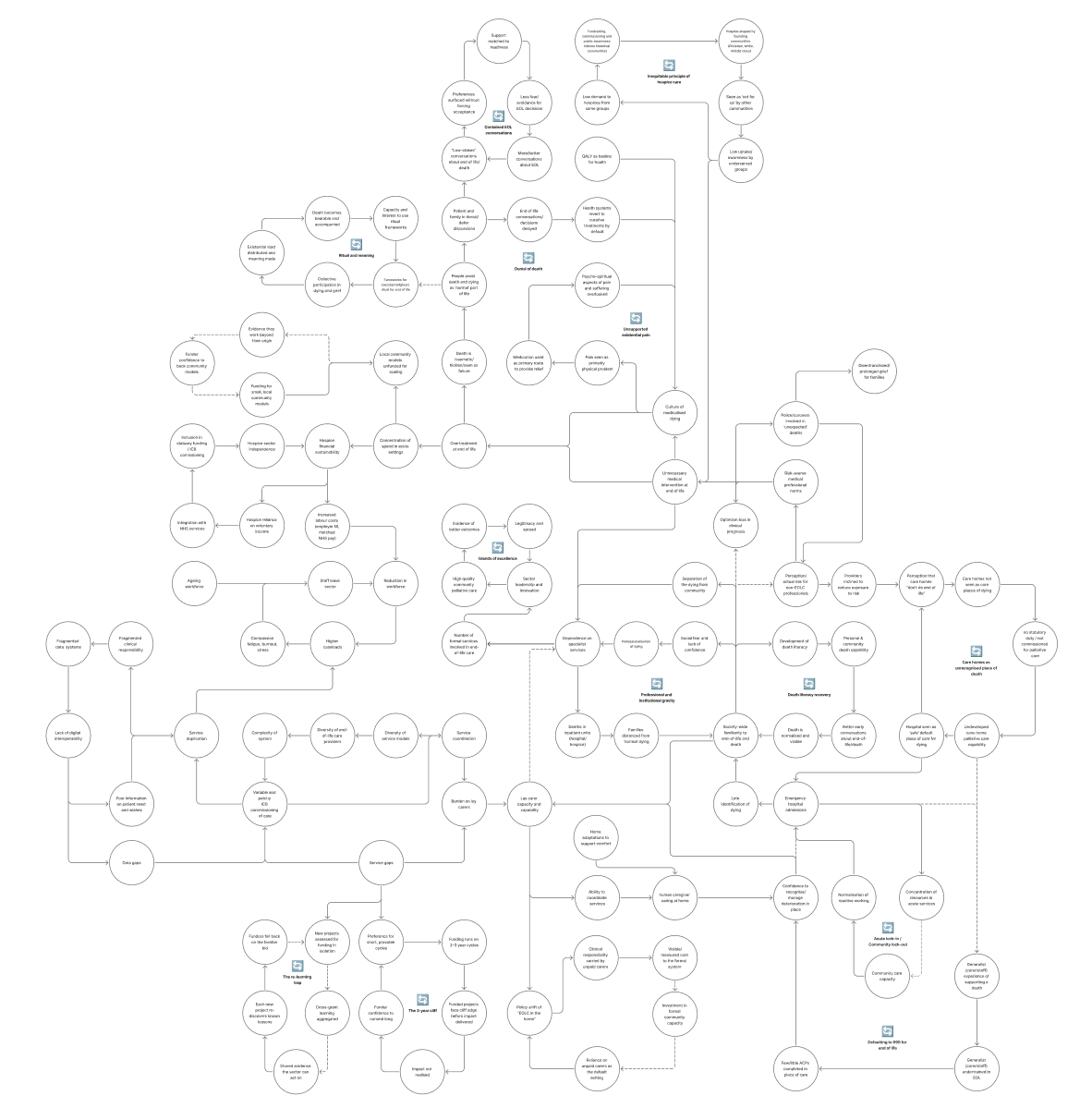
Chapter 2 set out what a good death looks like. This chapter asks why the system so rarely produces one, and where a philanthropic coalition could change that. Reform in palliative and end-of-life care has been attempted repeatedly, and much of it has not stuck. Our view is that this is because interventions have targeted single parts of a system whose feedback loops pull it back to where it started.
To avoid repeating that, we mapped many of those significant feedback loops. It provides us with a way to make sense of the inter-related aspects of palliative and end-of-life care and provide a wider view of the different effects and impacts various aspects of care have on each other. This has allowed us to identify the leverage points we believe can have a disproportionate impact. Maps such as these can be tricky to ‘read’ because they have no ‘start’, but can be seen as flows that can be started anywhere, and follow through to other areas.
The causal loop map underpins the rating system we use in Chapter 5 and the propositions we will develop in Phase 2. We expect this map to develop and grow over time, and should not be considered ‘complete’.
How it works
The nodes (circles) are factors in the system, the arrows are causal relationships between them.
Many of these loops are reinforcing. They are what make the current system 'sticky'. It can explain for example, why palliative and end-of-life care often defaults back to intensive, acute, medicalised treatment.
Some of these loops are balancing. They show how certain processes or interventions result in a stable feedback loop that can have a positive effect.
There are a number of named loops on the map. They represent a distillation of our research during this phase. They are incredibly varied and touch upon all aspects of the experience of caregiving, dying and death. They include:
the denial of death
death literacy recovery
ritual and meaning
islands of excellence
professional & institutional gravity
acute lock-in / community lock-out
the 3-year cliff
care homes as an unrecognised place of death
defaulting to 999
inequitable principles of hospice care.
carer capacity
system complexity and diversity
Our vision is for a palliative and end-of-life care system that helps people and communities to have as good a death as possible. The map helps to interrogate why that vision doesn't happen – to make the barriers, feedback loops, and lock-ins visible rather than argue them abstractly - so that our donor coalition can invest strategically and measure progress appropriately for a non-linear system.
What the map shows: two centres of gravity
Much of the map is organised around two clusters. One is cultural familiarity with death: how far people, families and communities know what dying looks like, can talk about it, and feel able to care for someone through it. The other is dependence on professional and specialist services. Most of the loops we identified feed one or the other, and the two pull against each other. The more dying is handed to professionals, the less familiar it becomes to everyone else. And the less familiar it is, the more it gets handed to professionals.
For most of the past century, that pull has run one way. As death came later in life and moved into hospitals and hospices, fewer people saw it at first hand. Families became less confident, care homes grew more cautious, and clinicians became more inclined to keep treating. Each of these increases reliance on services. The result is a system whose default response to dying is to call a professional, even when the professional can add little. Meanwhile the specialist workforce it relies on is shrinking.
This is part of the tension between the medical and social models from Chapter 2. Chapter 2 argued that a good death is a social experience with a medical component, and that professional, specialist care must not be devalued. The map shows why holding both is difficult. As things stand, every gap in what families and communities feel able to do becomes more demand for services, and services cannot meet it.
The answer is not to replace services with communities. As Libby Sallnow puts it, specialists should be "doing ourselves out of a job" by supporting a wider system, with recourse to a small group of specialists when needed. What matters is the balance between the two clusters. That has three consequences for a coalition:
Shifting the balance has the widest reach. Changing it touches many loops at once, which is why work on culture and community rates highest for leverage in Chapter 5. It is also the least evidenced and the hardest to exit.
Interventions on one side get pulled back. Something that works on one side without addressing the other tends not to last. Training care home staff does little if the fear of legal risk still sends residents to hospital.
The strongest opportunities give confidence and back-up together. They build confidence in families, communities and generalist staff while keeping specialist support within reach. The Kerala model and Compassionate Neighbours (as per below) both work this way.
Example loops
Below, we describe three of the twelve loops in full. Each shows the pull between the two centres of gravity from a different angle. The first shows the pull towards professional services at work across the system. The second shows it in the setting where more and more people will die. The third shows it in the conversations between clinicians, patients and families. Each also points to an opportunity area in Chapter 5.
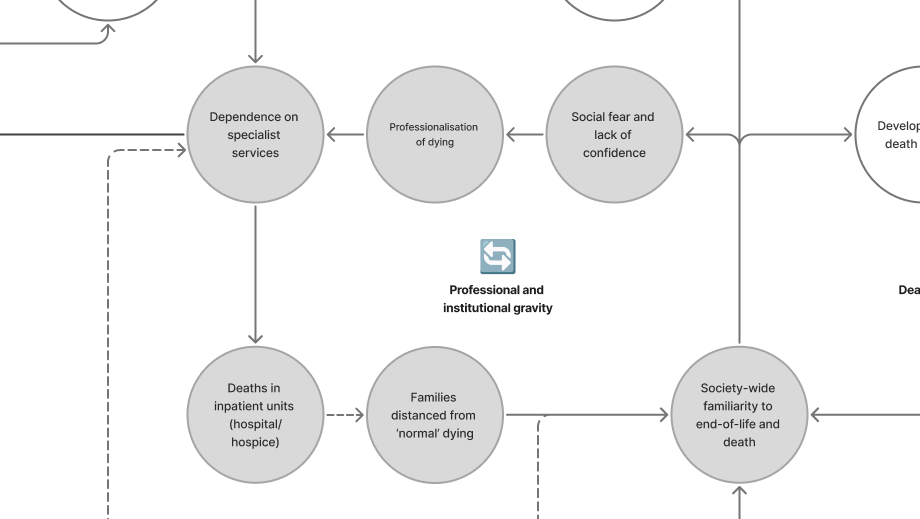
Professional and institutional gravity (balancing)
"The whole thing about palliative care is that we should be doing ourselves out of a job… supporting systems that can hold this with recourse to a small group of specialists. We can't have every single person dying with a specialist palliative care consultant at their bedside — the workforce could never follow that, the money could never do that, and it's not needed."
Dr Libby Sallnow, University College London
Most people die away from home. Hospitals absorb 81% of end-of-life spending despite decades of policy demanding a shift to community setting.20
When that happens, fewer families experience the dying process, which reinforces the lack of confidence and increases fear of it. This results in further reliance on professionals and specialist services, which in turn builds further dependency on them and more deaths in those services.
Moving dying people into specialist hospice settings "facilitated an unintended separation of dying people" and "encouraged the sense that other healthcare professionals are relieved from managing this part of a patient's illness."21
The more deaths occur in institutions, behind closed doors and out of public view, the more death becomes associated exclusively with clinical settings, further eroding the social and practical capacity to die elsewhere.
An estimated 100,000 people die each year in the UK needing but not receiving palliative care — a scale of unmet need that remains largely invisible to the public.22 Each institutional death reinforces the conditions that make the next one more likely.
Case study: Neighbourhood Network in Palliative Care, Kerala, India
The world's leading example of community-owned end-of-life care. Trained local volunteers, each giving around two hours a week, identify and support dying people at home, backed by trained nurses and doctors and integrated with primary care. Built from a single clinic in 1993, the model helped make Kerala (with 3% of India's population) the provider of roughly two-thirds of the country's palliative care, and in 2008 the first Indian state with a palliative care policy. It has been WHO-recognised since 1996.23 A 2024 study found that 69.1% of beneficiaries were satisfied with home care in Kerala. 24
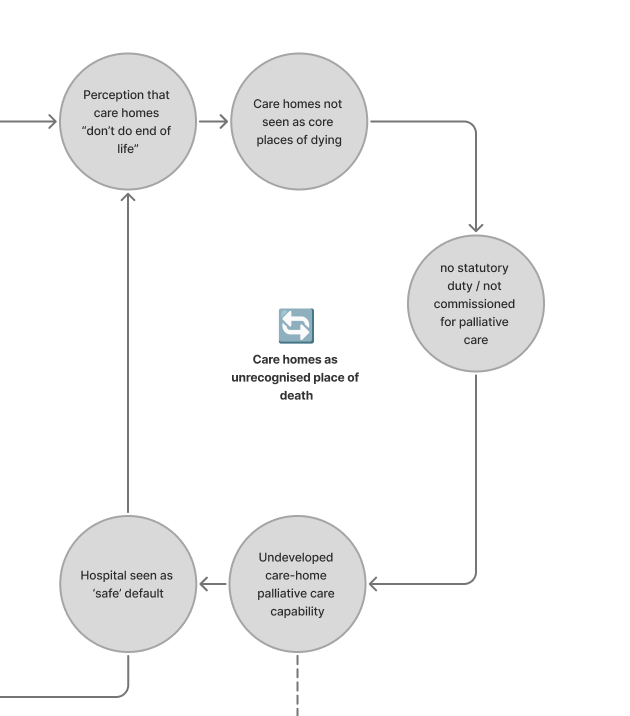
Care homes as unrecognised places of dying (reinforcing)
"Lots of care homes do amazing things that we could all learn from, in terms of helping people to live well until they die... let's value them in the system as well… [But] one of the big problems with care homes is that a provider will say, if this patient starts to deteriorate, we will call an ambulance and we will send them to hospital, whether or not we think they're dying, because they're worried about the risk and the risk of litigation… People beat care homes with a stick, and you just have to give them carrots. There needs to be a constant and consistent presence [of palliative care specialists], you can't just go and educate care homes and then walk away "
Sharon Hudson, Birmingham Community Healthcare
Care homes are becoming the place most people will die and will be on track to be the leading place of death in the UK by 204025, already accounting for around a fifth of deaths.26 Yet the system does not recognise them as places of dying, and that non-recognition (not any inherent inability to care) is what creates a reinforcing loop. Care homes carry no statutory duty to provide palliative and end-of-life care. What is not recognised is not resourced. As a result, care-home palliative capability stays undeveloped – staff often lack the training to treat general palliative care needs, recognise and manage deterioration without calling an ambulance. Often, the specific enablers of good practice (access to specialist support, clear role allocation, advance care planning built into routine, confidence to manage deterioration in place) are absent.27 So when someone deteriorates, the safe default is to send them to hospital, and every death that happens in hospital rather than in the home confirms the original perception that care homes 'don't do end of life', closing the loop. This picture varies greatly across providers, with some large chains actively engaged in palliative care as a service offer to clients.
Case study: The Netherlands' Buurtzorg model for in-home palliative care
Dutch home care had been broken into timed tasks split across staff grades, producing high turnover and sickness absence among nurses and little continuity for patients.
Buurtzorg reorganised delivery around small, self-governing nurse neighbourhood teams. Nurses deliver the full range of medical and support services themselves and build relationships with the household and the surrounding neighbourhood. As a result, patients needed care for less time, regained autonomy faster, and had fewer emergency admissions and shorter stays. An Ernst and Young study found Buurtzorg met patients' needs using 40% of authorised care hours, against a sector average near 70%. 28
Case study: Universal mandated health visiting contacts, the Healthy Child Programme, NHSE
While end-of-life care is not a statutory requirement for different care settings, elsewhere in the country there is already a universal, statutory model of care for another part of the life course. Every family with a young child is entitled by law to five health visitor reviews – from pregnancy to age 2.5 – with extra, targeted support layered on for those who need more. Made mandatory in 2015 and rooted in Sure Start, it embodies "proportionate universalism": a baseline for everyone, more for those with greater need. IFS evidence shows this design has cut child hospitalisations most in the poorest areas.
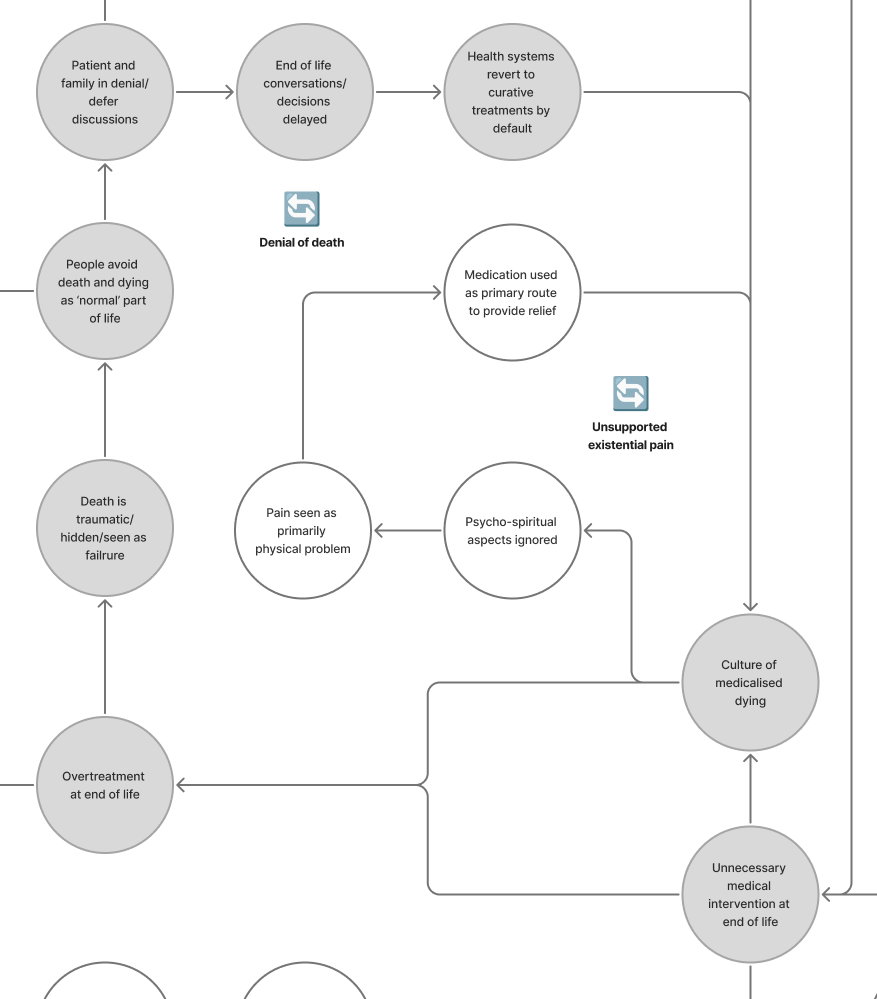
Denial of death (reinforcing)
"There's now a real unwillingness on the part of society, and I include healthcare and everything in that, to tolerate sadness and distress… There's always one more course of antibiotics, one more bag of fluids "
Dr Libby Sallnow, University College London
Denial of death can be described as a personal psychological state (coined by the cultural anthropologist Ernest Becker)29 which frames the innate human desire to avoid thinking about and engaging with death. But it is also something the larger palliative and end-of-life care system manufactures and then acts on, with direct clinical consequences. Because death now comes late in a long life and is hidden inside institutions, people often arrive at the end unprepared: "there's always one more course of antibiotics, one more… you can always chuck another bag of fluids up," and beneath that a "disbelief that mortality is actually real". That disbelief has lasting impacts. It defers the conversations that make a good death possible. Almost a third of bereaved families say a professional never discussed the possibility that their relative might die,30 and the Commission found honest conversations "often delayed until patients were too unwell to participate".31
There are two interventions directly affected: Advance care planning (the sector's main tool for honouring wishes) is stunted. When denial defers the conversation, the plan is never made or is made too late to travel with the patient, and the evidence that ACP as currently practised changes outcomes is already weak.32 In the vacuum left by the deferred conversation, the system reverts to its default setting: curative treatment. Two-thirds of patients on palliative chemotherapy for lung cancer, and four in five for colorectal cancer, believed the treatment was meant to cure them33; a £50,000/QALY threshold rewards marginal life extension;34 and clinicians keep intervening against the trajectory. This is overtreatment "likely to produce more harm than good"35, driven as much by a psychospiritual refusal to accept dying as by any clinical judgement.
Constraints
The causal loop map describes how various aspects of the end-of-life system care behaves. The loops that concentrate dying in institutions, defer the difficult conversations, and pull coordination apart. Those loops are held in place by structural features that persist inequitable and undesirable outcomes. The rules, resource flows and gaps that decide what the system funds. A credible case for change has to begin by highlighting these constraints.
Each constraint below also has a positive way through, where leverage can sit and highlight where philanthropic capital could unlock change. This is the case taken up in Chapter 3.
Short term funding
"Many innovative ideas demonstrate positive outcomes locally but end just as relationships, trust and community participation are beginning to develop"
Dr Katy Vigurs, DEAD GOOD
"[At the hospice] we took on lots of restricted funds for new projects for three or five years and then ran out of funding. The expectation for everyone was that the project would continue [...] but there was no real long term planning of how we were going to fund that."
David Burland, db associates
"There are often little pots of money available temporarily in the NHS and at short notice. Implementation is often very rushed so not very well done and then funding comes to an end before there is a chance for improvement or to evidence impact."
Dr Lucy Pain, North London Hospice / North Middlesex University Hospital NHS Trust
Governmental support during the pandemic left hospices with the strongest balance sheets in their history; within 5 years that has been undone and most independent hospices now run at a deficit. Compounding the problem for any innovation work in that context is the fact funding is allocated with 3-5 year grants, with an unspoken expectation that the service will continue and no plan for how. Initiatives build local dependency and then disappear when the money ends.
Non-cash releasing savings
"The return was a reduction in bed days in hospital. But of course the hospital beds just get filled up again. That wasn't really translated into real money. So we were saving the system, but there wasn't real money being saved."
Dr Bee Wee, Oxford University Hospitals NHS Trust
"[A structural constraint is…] organisational boundaries, including the inability to reinvest savings in acute care into community capacity. Acute beds will always be filled by someone else where unneeded admissions towards end of life are avoided."
Mark Hazelwood, Scottish Partnership for Palliative Care
It is widely acknowledged that reducing the amount of people spending their last hours and days in a hospital is a desirable outcome. The difficulty is that reducing the amount of time spent in a hospital bed is a non-cash-releasing saving: a bed not used by someone at the end of life is used by someone else. A saving to the system never becomes releasable. Payers cannot fund a saving that does not return to their own budget.
Ageing workforce
"The biggest issue is really that people don't feel able to rely on good quality, responsive nursing care in the final weeks or months of life, they feel unsafe because professional care is not reliably available or consistently good. It isn't specialist care that we need more of, just good quality basic personal care and access to injectable medications available 24/7. A key part of that must be improving confidence in care homes."
Dr Lucy Pain, North London Hospice / North Middlesex University Hospital NHS Trust
"Nurses who work at the coal face here are constantly problem solving and building workarounds. They don't have any pathways, processes or supporters to bring their ideas to life, much less scale."
Kirra Moser, MyStand.In
It is understood that the nursing workforce in the UK is in a poor position to respond to the growing need for care. District nursing has seen a 43% decline in overall numbers since 200936. Over the next 10 years approximately 33% of the consultants working in palliative medicine are likely to retire and exit the workforce37. It is not realistic to replace that level of specialism during that period of time. What is more realistic is the model of care itself. The leverage lies in re-distributing capability to generalists and carers who already deliver most palliative and end-of-life care (either formally or informally) rather than concentrating on the specialist core.
Unlinked data
"Hospice data is not linked to any other NHS data, which is a massive failing."
Professor Katherine Sleeman, Kings College London
Across the UK, hospice data is not linked reliably to NHS or social care data. This means care records and other important information does not follow a person as they move from setting to setting, or connect what does, to particular outcomes. The lack of data to explain outcomes is a persistent gap that means that commissioners who may want to do things differently, are unable to prove initiatives work. The data exists, it is just often unlinked. The siloes of data remain the remit and ownership of each service, and no one is responsible for linking them, and so it never happens.
Risk and legal responsibility
"Professional anxiety and discomfort around perceived risks of community/home based initiatives is a really big issue"
Dr Lucy Pain, North London Hospice / North Middlesex University Hospital NHS Trust
"[Paid carers are] terrified of making the wrong decision because they've got no protection, so they just call 999.
Dr Libby Sallnow, University College London
"Institutions and organisations need to stop worrying about risk to their reputations and instead support their workforces in positive risk taking."
Dr Sarah Yardley, University College London Hospitals NHS Foundation Trust
Supporting someone through the process of dying brings legal risk and responsibility. If a person dies without it being expected the police will visit the scene and a coroner's review will be carried out. Personal and professional unfamiliarity with death makes it more likely that dying won't be recognised, heightening the risk. Within acute services this might result in a person being given unnecessary medical intervention (avoiding to the doctor of complaints and potential General Medical Council referrals) or a person being stuck in hospital because social care services do not want to take on the risk of discharge. Within care homes and home care this might result in defaulting to 999 because the carer does not feel protected from legal risk associated with death. It is also a barrier to easier access to pain-relief medication at home for patients and carers.
Lack of ownership of the whole experience
"There is very little co-ordination between hospices, hospitals, community services, care homes etc. UK healthcare is fragmented, not a single, joined-up system."
Dr Lucy Pain, North London Hospice / North Middlesex University Hospital NHS Trust
"Individuals or organisations [are] not able to 'take off their organisational hats' to work together to deliver system change."
Dr Sarah Holmes, Marie Curie
"[There is] dispersed care across 100s of hospitals and hospices all answering to different bosses and managers and funders while being stretched excruciatingly thin."
Anonymous practitioner
Palliative and end-of-life care is a holistic experience that in reality is delivered by a number of different sectors and specialties. From NHS geriatric services to charity bereavement service, from family-run funeral providers to for-profit care homes. Higher leverage changes - such as improving death literacy - cut across these disparate sectors but are not owned by any institution or organisation. There are pockets of change being delivered, but there is no coordination or strategy between them.
Natural scale of good models
"It seems that once something is created people think it can be 'done at pace' and 'at scale' which ignores the vital components of ownership and co-creation."
Dr Sarah Yardley, University College London Hospitals NHS Foundation Trust
"There is no route for spreading across multiple care homes/hospices — there are chains but they don't actually do much to bring together their staff, each place is isolated."
Tom Wein, IDinsight Dignity initiative
"What works in one area is hard to replicate due to the mixture of services/ people/ funding... Things struggle to be sustained as they often rely on specific people (champions, knowledge brokers)."
Professor Erica Borgstrom, Open University
"A much more serious problem than 'failing to spread' is 'inappropriate spreading'... There is far too much blind adoption of non-evidence based approaches in palliative care and it causes harm."
Professor Katherine Sleeman, Kings College London
Many of the best community approaches work precisely because they are small and local - working at a scale where relationships and trust can do the work - and don't work when simply transferred elsewhere, wholesale. They also tend to rely on specific, exceptional, driven people who equally cannot be simply replicated elsewhere.
Chapter 4: Philanthropic funding in palliative and end-of-life care
Chapter 3 showed where the system is stuck. This chapter asks what role money plays in keeping it there, and what a coalition's money could do differently. The coalition needs to know four things before it commits financially.
The first is scale. Around £22bn of public money is spent each year on people in their last year of life. Any philanthropic fund will be small by comparison, so it cannot replace public spending. Its value lies in changing how that spending is used - acting as first loss capital that can take risks on innovation that public funding cannot.
The second is where philanthropic money goes now, so our coalition can see the gaps and avoid duplicating what others already fund.
The third is what other funding instruments have achieved in this field, and where they have fallen short.
The fourth is what principles should guide a coalition's investment as a result.
We take these in turn. We begin with the money around the system: public spending, what households pay, and private capital. We then look at philanthropy in detail, drawing on a decade of grants data and the published accounts of 17 hospices, and at what social investment has taught the field. Our central finding is that almost all of this money sustains the system as it is or improves it at the margins. Very little backs the experiments that could change it. This missing middle is the space we think a coalition should fill. The chapter closes with the principles for doing that, and examples of funders elsewhere who have tried.
How end of life care is funded today
The funding model for end of life care - including how philanthropy currently works - is both a contributor to and condition of the failures in today's dominant end of life care system. For the system to change, funding models and philanthropic discipline also needs to change.
Funding for home-based end of life care comes predominantly from public funding and households' own money. Broadly speaking, philanthropic and money plays a key role in maintaining the hospice sector, venture capital is active in the care home sector, and outcomes-based social finance is enabling innovation in primary and secondary health care.
In this chapter we first look at overall financial flows in the space, before focusing in on the philanthropic funding landscape and two important social finance programmes. We aim to detail the principles by which new disciplined philanthropic investment could be deployed.
Public money
The primary source of funding for end of life care is public money. The Nuffield Trust and the Health Economics Unit estimate that around £22 billion of public money is spent on people in the last year of life in the UK38. This is roughly as much as the Home Office's entire budget, covering everything from policing to counter-terrorism to borders.39
Over half of this total expenditure (almost £12 billion) was on health care, 22% (almost £5 billion) was on social care, and 25% (£5.5 billion) was on social security like state pension payments.
| Category | Spend | Share |
|---|---|---|
| Health care | £11.9bn | 53% |
| Social security | £5.5bn | 25% |
| Social care | £4.8bn | 22% |
Source: Nuffield Trust, Health Economics Unit.
The NHS spends £11.9bn on end of life healthcare annually. For comparison NHS maternity services are funded In 2021/22, overall spend on NHS maternity and neonatal care was around £4.9 billion.40
Within healthcare, the UK spends five times as much on supporting people in the final year of life as hospital inpatients, as we do supporting them with primary care, community health and hospice care. The vast majority of money is concentrated in emergency reactive care. Healthcare spending is nominally directed by Integrated Care Board commissioning decisions, though in practice much of it, particularly emergency and acute activity, is driven by national payment mechanisms and demand rather than by deliberate local choices.
| Category | Spend | Share |
|---|---|---|
| Total | £11,749m | |
| Emergency care | £7,075m | 60.2% |
| Planned hospital care | £2,950m | 25.1% |
| GP & community care | £1,310m | 11.2% |
| Hospice care | £414m | 3.5% |
Source: Nuffield Trust, Health Economics Unit. Emergency care = unplanned care in and out of hospital; GP and community care = GP practice and community subtotals. Categories may not sum to total due to rounding.
For social care expenditure, the largest element is residential and nursing home care (63%), paid for by local authorities. Local authorities have a statutory duty to assess and arrange residential and nursing care for those with eligible needs, but they only fund it for people who fall below the means-test thresholds. Continuing Healthcare (CHC) is a package of care funded by the NHS. And the £170m 'other' covers things like the home adaptations and equipment.
| Category | Spend | Share |
|---|---|---|
| Total | £4,851m | |
| Residential & nursing care | £3,077m | 63.4% |
| Continuing Healthcare | £1,047m | 21.6% |
| Home care | £557m | 11.5% |
| Other | £170m | 3.5% |
Source: Nuffield Trust, Health Economics Unit.
Many of the dynamic loops described in Chapter 2 are tied to public funding models.
Household money
Individuals and their families also contribute both as charitable givers and as private customers within end of life care.
A key funding source for hospices is individual donations (e.g. money raised through donation campaigns and fun runs). Evidence from hospices UK shows that on average 27% of independent hospices' total income is from donations (£351m, though this figure also covers grants from trusts and foundations), and 18% is from legacies (£234m).41
Contribution as private customers is more challenging to calculate. However, the ONS estimates that 37% of care home residents are self-funders in England.42 LaingBuisson values the private pay market for care homes in the UK at £14.1 billion, though only part of this will be for end of life care.43
Venture and private finance
A third pool of capital circulates around end of life care. Though this is wider than end of life care it is a useful context. UK healthcare real estate attracted £12 billion of investment in 2025, around four times the five-year average, driven overwhelmingly by US REITs acquiring care home portfolios. Welltower alone deployed over £7 billion in the UK care sector that year.44 LaingBuisson values the wider UK care home market for older people at £27.3 billion,45 and the homecare and supported living market at a further £12.4 billion (this also includes care for all ages),46 much of it consolidated under private equity ownership.
There is some venture capital aimed more directly at death and dying, but has struggled to find a workable return: Farewill, the best known UK 'death tech' start-up, raised around £30-39 million from investors including Augmentum Fintech and Highland Europe, but was sold in 2024 for just £12.9 million.47 This illustrates some of the challenges for commercial capital in the case, and therefore the key role for philanthropy.
More developed commercial innovation pathways are also active within the medications, technologies and devices that support people at end of life.
Funding case study: Seed funding for high-potential early stage innovations
Cancer Research UK found that discoveries stalled in a specific gap: too early for venture capital, too commercial for research grants. Its Seed Fund began with a £15m cornerstone commitment from the charity and has grown beyond £25m through a £10m donation from the Garfield Weston Foundation and other philanthropic gifts. It invests £50k to £1.5m across pre-seed, seed and follow-on stages, alongside venture-creation support. Returns are recycled into the fund and further research, which allows it 'to take risks others cannot'. To date £8m committed across 26 investments has secured £32.9m in co-investment, roughly four to one leverage, and other investors treat its presence as validation.
Funding case study: Venture-building for healthy aging
Zinc builds commercial ventures against defined social missions, on the conviction that a mission can be both a social and a commercial opportunity. Its Later Life mission set an explicit goal of adding five high-quality years to later life. Each mission recruits a cohort of 50 to 70 entrepreneurs before there is a company to join, running a nine-month programme: three months finding a co-founder and settling on a problem, three prototyping, three preparing for investment. Zinc takes an 8% equity stake in the companies formed. Its second fund closed a first tranche at €32.9m, backing around 100 businesses, with investors including Big Society Capital and Dunhill Medical Trust. Over 300 entrepreneurs have been backed and more than 60 ventures built. The Later Life mission also created Ageing Champions, older adults who shaped products by sharing their own experience of growing older.
Philanthropic money
Patterns of funding
Our analysis for this report, using the 360Giving database. found that philanthropic funding of UK palliative care amounted to approximately £92m over the last 10 years (2015-2025) across 3,494 grants.48 This is a comparatively small amount of money - just £9.2m a year on average for a sector supporting more than 500,000 dying people a year. This is a partial assessment only of grant funders who contribute to the database.
Excluding a spike of grant-making by The Julia Rausing Trust in 2023, the underlying grant-making trend from 2019–2025 is flat or declining in real terms.The field is also dominated in volume by very small grants, just £3,8000 on average. A few larger grants however make up the majority of the value.
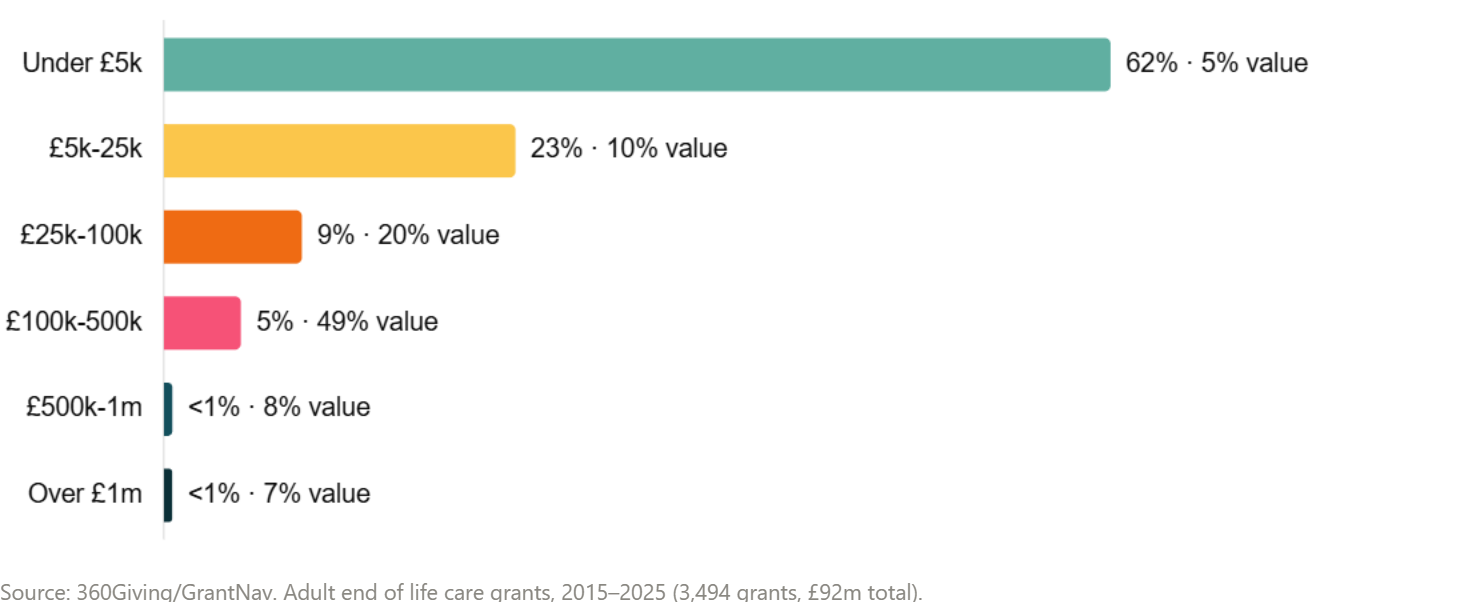
Geographically speaking, London and the South East dominate funding. For example, We identified £23m of grants within London over the period, compared to£3.6m for the North East and £2.8m for the West Midlands. Funding in Northern Ireland appears to have collapsed over the period to just £280k.
There is no large strategic systems-change funder for the field. The biggest philanthropic player by value is the National Lottery Community Fund at £48.6m, but with a median grant of £10k it is essentially a service delivery and community grants programme, not a systems investment fund.
Grant-making is almost entirely directed at institutions – e.g hospices, national charities (Hospice UK, Marie Curie, Sue Ryder) – rather than at innovation, infrastructure or system-level change projects. In our searches for example, only 2 grants mention 'digital', and just 10 mention 'dementia' despite it being the dominant condition at end of life.
Many people we spoke to as part of the research described how current philanthropic funding approaches are failing the system.
"Innovation in end-of-life care doesn't fail because of a lack of good ideas. It often fails because funding and systems favour short-term projects, organisational silos and clinical interventions over long-term cultural change"
Dr Katy Vigurs, DEAD GOOD
"The model of what we do [in the NHS] has not changed and is not open to change because [philanthropic funders] like what third sector do, so this then suppresses change [elsewhere]. Palliative care delivered by hospices could be so much more ambitious but funding concerns do not allow for it."
Lisa Kennedy, NHS Greater Glasgow and Clyde
Grant recipients
Looking directly at funded organisations' accounts gives us a richer picture beyond the 360 Giving database. Our analysis of a sample of 17 hospices surfaces 262 unique named funders. Of these, only 22 (7%) appear at more than one hospice, and only 8 (2.5%) appear at four or more. Very few are on 360Giving. The pattern is predominantly one-to-one: a funder gives to one hospice. The philanthropic ecosystem is not coordinated but an aggregation of hundreds of independent bilateral relationships.
Case study: Compassionate Neighbours, St Joseph's Hospice, London
Local people were trained as "Compassionate Neighbours" and matched with isolated people near the end of life to build ordinary, reciprocal friendships. Begun at St Joseph's Hospice, Hackney, in 2014 and scaled with Nesta/DCMS funding; the 2019 evaluation counted 901 neighbours supporting 541 community members across eight hospices, now around 14. Its own evaluation found the volunteers gained as much as those they visited.
The funding is dominated by small-to-medium trusts with no apparent strategic intent around EOL specifically. Many named grants fund discrete, tangible items - beds, scanners, syringe drivers, IT equipment, staff training bursaries - or core costs - rather than service models, infrastructure or innovation. This reflects funders responding to hospice asks rather than deploying capital against a theory of change.
Our evidence surfaces almost no visible capital directed at community-based or systems-change work. A few exceptions are the Edward Gostling Foundation's £1.5m virtual ward grant to Thames Hospice, the Hadley Trust's work with Royal Trinity, and the City Bridge Foundation's multi-year bereavement therapy commitment to St Christopher's.
Geographic concentration is notable. St Christopher's alone names over 80 funders - more than all the non-London hospices combined. London hospices attract a distinct funder profile: major City law firms, investment banks, auction houses, and large national foundations. Regional and Scottish hospices draw almost entirely on local trusts and community foundations, with much smaller individual grant values.
Funder profiles
The following are indicative of philanthropic funders that range from family trusts to national foundations.
National Lottery Community Foundation
TNLCF is the biggest single funder by volume. It has two giving modes: a high-frequency small grants machine (190 grants under £25k, just 10% of value), and a much smaller but more interesting innovation funder at the £300k–£500k level. The large grants (56 grants over £100k delivering 75% of value) include Compassionate Neighbours, Inside-Out Hospice, Palliative Care Coordinator for Homeless People but those programmes peaked in 2015–2019 and haven't returned at scale. Interestingly they funded the End of Life Care Incubator, an innovative model which received £1.88m across 3 grants from TNLCF in 2017–18.
Julia Rausing Trust
Julia Rausing Trust has two giving models - targeted grants, and then a single round of 'core costs' funding in 2023. No grants have been made since. The 2023 grants look like a focussed sector stabilisation effort post-COVID.
Wolfson Foundation
Wolfson is the most consistent and systematic funder in the dataset. It funds a series of hospices every year across a broad geographic reach. It is largely an infrastructure and workforce funder: buildings, equipment direct to hospices, and sector-wide workforce development channelled through Hospice UK (£1.4m across three grants).
Garfield Weston Foundation
Garfield Weston has a wide reach - funding 80+ distinct organisations with a median of £25k. The one exception is a £280k grant to Cicely Saunders International - a research and policy body rather than a direct service provider.
Albert Hunt Trust
Funds 8 of the 17 hospices in the sample with no clear geographic constraint. Grant values appear to be in the £10k–£25k range.
Edward Gostling Foundation
A funder in the sample of hospice accounts making a grant explicitly designed to fund a service model (Thames Hospice's virtual ward, £1.5m over several years) rather than a capital item or staff cost. Also appears at Overgate's Big Build Appeal.
City Bridge Foundation
London-focused but making multi-year, programme-level grants (£231k over 5 years to St Christopher's for child bereavement therapy; £49k to St Joseph's for welfare benefits). Appears at 4 hospices. It gives multi-year, service-level funding.
St James's Place Foundation
Appears on 4 sampled hospices' accounts and operates a named programme through Hospice UK (Dying at Home with Dignity, 14 grants in one year). This is a corporate foundation using a national intermediary to deploy at scale across the sector, rather than giving directly.
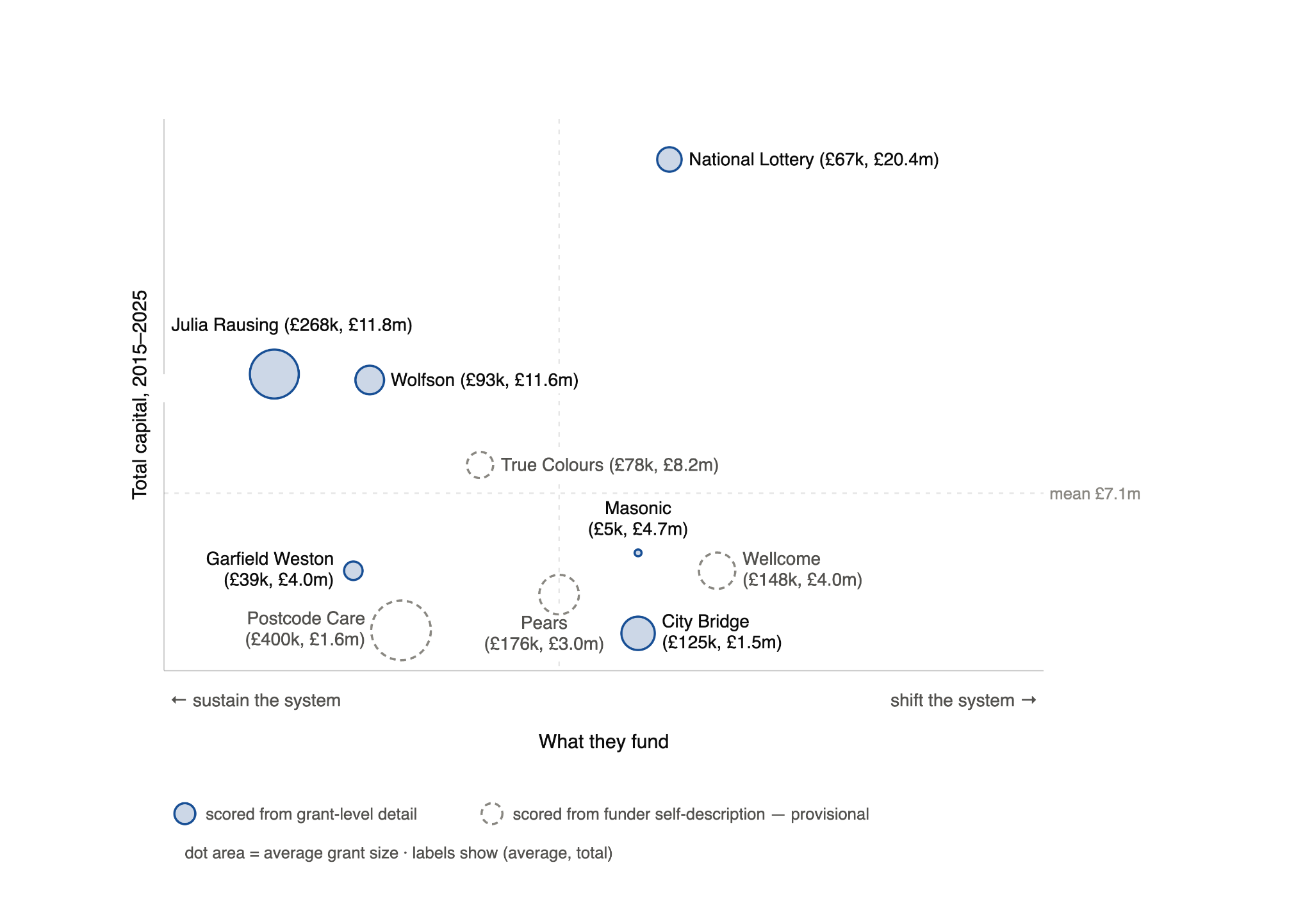
This Donor Map (v1) plots the 10 largest funders of adult palliative and end-of-life care (2015–2025) on two axes: (horizontally) whether their grants sustain the existing system or shift it, against (vertically) how much capital they deployed, with dot area showing average grant size.
Social finance
Repayable, social capital is also at play in the sector. There are two significant examples both run as a partnership between Macmillan and Social Finance UK, with outcomes-linked top-up support from government Commissioning Better Outcomes Fund and the Life Chances Fund: £12m Care and Wellbeing Fund; £36m Macmillan Social Investment Programme for End of Life Care (2021-present). Both funds use outcomes-based contracting to try and fix systemic issues in end of life care: spend concentrated in acute care, little capacity within the system for innovation, and poor join-up between health and social care.
"Without that social investment, we couldn't do it [RIPEL], because the social investment gave us the additional workforce, it gave us the head space. It also gave us the permission to fail, we could design something and modify it as we went along, rather than most grants where you have to decide what you're going to deliver upfront."
Dr Bee Wee, Oxford University Hospitals NHS Trust
The Care and Wellbeing Fund's evaluation provides a useful insight into the successes and challenges of the model. It has produced sector-leading initiatives (see box-out). However, financially, it did not deliver the return investors were promised: against an original projection of 4% annual returns, it was tracking toward an IRR of -11% a year once all costs were accounted for.49 Outcomes-based contracts cap the returns at the value of the underlying contract, so a handful of successful projects cannot make up for the losses that innovative, higher-risk work will produce. Three-to-five year contracts rarely generate enough return to fund the full cost of innovation on their own. Top-up philanthropic funding, layered on from outcomes-linked government programmes, helped offset this.
Social finance approaches work relatively well for interventions with a bankable, near-term outcome, something like a single point of access service or advance care planning at scale, where a reduction in bed-days can be measured and, in principle, repaid. It is a more challenging fit for paradigm-level, community-infrastructure and death-literacy work because that work rarely produces contractable, cash-releasing savings for a single organisation. Indeed, while the Care and Wellbeing fund initially set out to support innovative social enterprises in this space, it found its best strategic opportunities lay in primary care instead.
The evaluation also suggests that what commissioners and delivery partners valued most was not the capital itself, but the capability and capacity that came with it: the discipline of an outcomes contract that clearly linked funding to results, and the partnerships the fund's team could broker.
Case study: Social Finance/Macmillan funded projects
RIPEL (Oxfordshire) combines hospital rapid response, home hospice care, virtual ward outreach and a telephone hub as a coordinated set of services, run out of Oxford University Hospitals in partnership with Sobell House. It has cared for over 4,500 patients, enabling 23,445 extra days at home rather than in hospital in their last year of life. The hospital trust now funds the service directly.
REACT (Bradford) places clinicians inside Bradford's Emergency Department to catch dying patients and get them home, backed by a 24/7 community rapid-response team. Launched 2022 and funded through a social impact bond, it saved 18,416 hospital bed-days and gave 1,282 people access to personalised palliative care in its first 2.5 years - roughly halving the time REACT patients spent in hospital in their last year. Now sustained on mainstream NHS funding.
Hillingdon (Your Life Line) is a single 24-hour phone line for palliative support in Hillingdon supported 2,275 people under Social Finance investment. 93% of patients died in their preferred place, up from a 65% baseline. When the investment ended in 2021, the local commissioning group chose to fund the service permanently.
End of Life Care Incubator (North West London) gave care home staff telephone access to clinical advice and support, supporting 9,016 people cumulatively. At its peak, in March 2022, it avoided 303 non-elective admissions in a single month, a 25.8% reduction from baseline. It was ultimately decommissioned, overlapping with other emerging services and falling short of both its planned capacity and its planned effectiveness.
Philanthropy as discipline
Taken together, our analysis indicates that the majority of money active within end of life care is working to sustain and improve the system as-is. This primarily resources the dominant medical paradigm of dying. High quality medical and social care provided by well-run and joined up services is vital. However the concentration of money in this part of the system means that system-changing work - like redesigning human systems, building relational infrastructure - is underfunded and subject to 'death by pilot' [Hayley Hans]. This leaves a missing, messy middle where smart, disciplined philanthropy could act.
Funding systems change in end of life care
The best way to understand this 'messy, missing middle' is through the three horizons systems change framework developed by Bill Sharpe.50 All three horizons are always present at any one point in time.
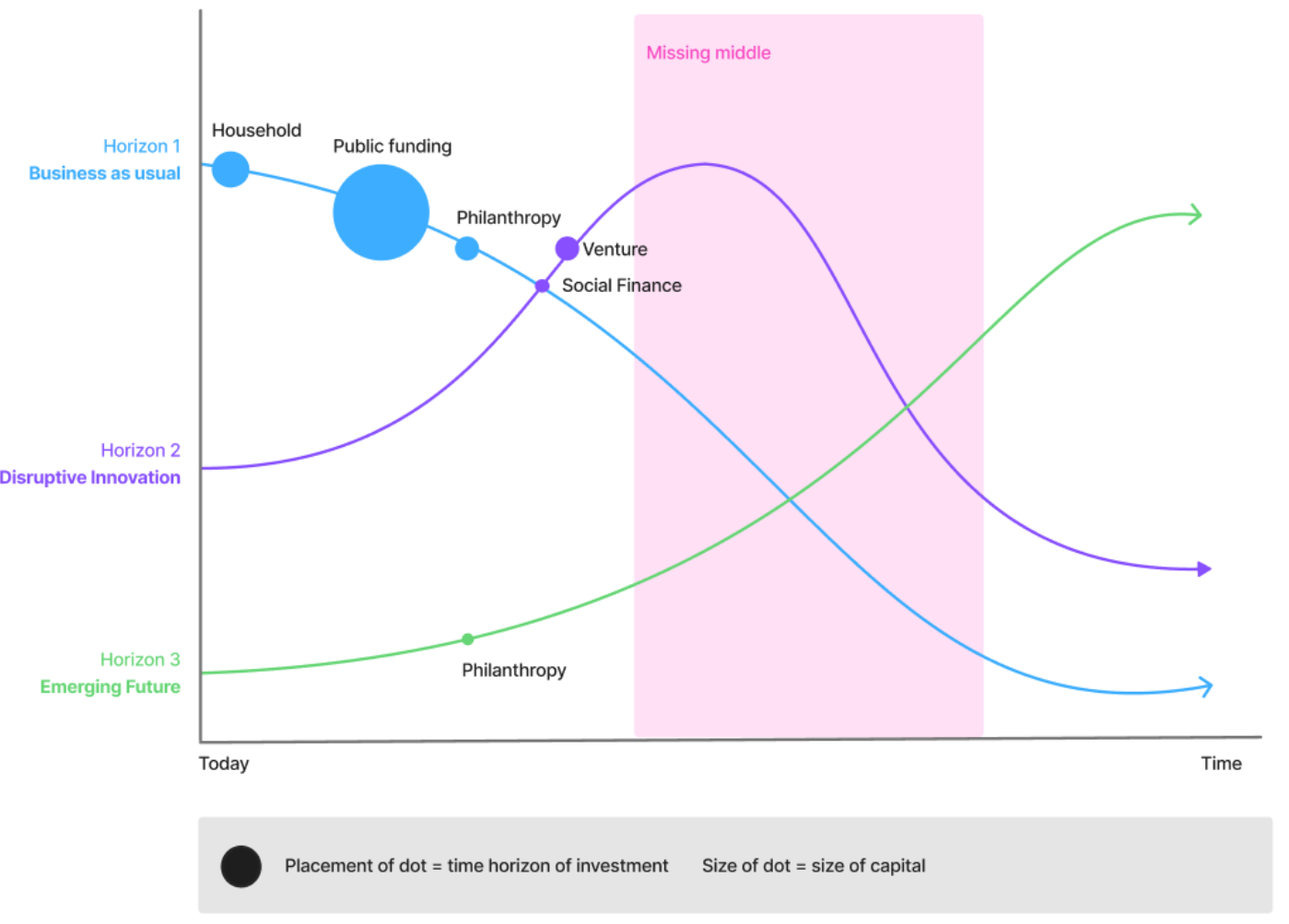
The first horizon 'business as usual' refers to the prevailing, dominant system.This horizon is under increasing pressure and showing signs of strain because the world is changing. In the end of life care system this is the pattern of emergency A&E admissions, unmet palliative care needs, chronic under-funding of hospices, and over-burdened carers. This is what public money runs, and what legacies and donations typically go into sustaining. Much private finance is also active here, financing clinical innovation and proven products like care homes. And this is the system that individuals pay to receive care within.
The third horizon 'emerging futures' is the space of emerging paradigms, ideas and innovation. It is the system waiting to be born. But this future is contested. Through one lens (what our research indicates is most promising) seeds of that future for end of life care in the present look like the Death Doula movement, compassionate communities, and a cultural shift to realise the value of death. Another set of people might be working to bring a privately-funded technologically-driven end of life care system into being. Work in this horizon today is often riskier and unproven. In our model, what little funding goes into it at the moment is usually in the form of short-term charitable grants.
The second horizon 'disruptive innovation' is the space of both incremental adjustments and transformational experiments. In this space are opportunities - all kinds of novel things might work in this moment to shift the system. Work in this space can either be captured to sustain business as usual or harnessed to bring forward the emerging future. In the end of life care system disruption is coming from new technologies, changing social norms, government healthcare policy and much more. Currently some public money and social finance goes into this space for service transformation, and venture capital works to harness the upside of disruption by funding innovation.
The missing middle. The space of the second horizon is where we think philanthropists could have some of the greatest impact in the space - it is where there is genuine leverage to shift the system. However, our analysis indicates that much of this money is going into bridging the first and second horizon (important, incremental adjustments) in a way that leaves the bridging of the second and third horizon (transformational experiments) largely unfunded.
Between these two kinds of disruptive innovation are several tensions:
Evidence. The value of incremental adjustments can be proved within the language of the dominant system and with clinical/service outcomes. Transformational experiments often express value in different terms, such as cultural change and psychosocial wellbeing, that can be more diffuse and abstract.
Who the customer is. The former has a 'buyer' already within the actors of the dominant system. The latter needs to create a 'buyer' or might not have one at all.
Financial mechanisms. The former has more guaranteed and legible returns (financial or social) and so is fundable by public money, private finance, and philanthropists expecting set outcomes. The latter is experimental and so is only really fundable by philanthropists with a high risk appetite or private individuals.
Our donor coalition will seek to tackle these tensions head-on and fund this missing middle.
Principles for new philanthropic investment
The evidence suggests a case for a new kind of philanthropist investment in this space. And while interviewees and survey respondents had different suggestions for where this money should go (the 'what' is explored in Chapter 3), there was strong consensus around a set of underlying principles for a donor collaborative:
| Current philanthropy | Emerging, future philanthropy |
|---|---|
| Propping up a system in crisis | Stewarding a system in transition |
| 'Crazy paving' of small, uncoordinated grants | Coordinated architecture of larger grants |
| Short term (1-3 year funding) | Medium term (3-10+ year funding) |
| Fund services | Fund problems |
| Funds organisations | Funds ecosystems |
| Funds pilots | Funds conditions and spreadable models |
| Individual as beneficiaries | Communities as beneficiaries |
| Grant funding cliff-edges | Philanthropic exit designed-in |
| Fills public funding gaps | First-loss capital builds case for public investment |
| Charitable-only | Blended stack of charitable, recyclable, public and private finance as needed |
"[We need] long term, 10 years plus, funding programmes that allow time for authentically building relational models and multiple cycles of innovation."
Dr Sarah Yardley, University College London Hospitals NHS Foundation Trust
"Investing in the capability to develop and spread innovation is likely to have a greater long-term impact than funding individual innovations in isolation"
Dr Lucy Pollock, Somerset NHS Foundation Trust
"Philanthropy is uniquely placed to fund ideas that statutory systems often cannot: creative experimentation, community-led approaches, ecological innovation and cross-sector partnerships"
Dr Katy Vigurs, DEAD GOOD
We can look outside of the end of life care system to find promising models for philanthropy, investment and public innovation funding working in the mould of that 'emerging' model.
Funding case study: Field-building for end of life care in America
George Soros established Project on Death in America (Open Society Institute, 1994–2003) after his parents' deaths, at a point when research showed half or more of dying Americans reported uncontrolled pain, their wishes unknown or unhonoured, and half of families bankrupted by hospitalisation. The judgement was that the decisive intervention lay in changing the culture of medicine in hospitals and nursing homes, where 80% of Americans die. It ran for nine years, distributed $45m, and closed on completion, publishing a report written specifically for other funders. Its central instrument was field-building rather than service delivery: a network of 87 faculty scholars developed as palliative care leaders and role models, and more than half the fund went to professional education. The scholars became prominent figures in US palliative care.
Funding case study: Long-term funding for outcomes rather than projects
The Solidarity Fund is the National Lottery Community Foundation's flagship new fund. It aims to shift the organisation from funding community projects to funding community power. It invests in the building blocks of community-led change rather than in defined services. Almost £60m was awarded to the first 13 organisations in June 2026, for example the Black South West Network receiving £5m over ten years. The fund backs organisations that already hold strong community relationships, giving them stability to build on existing work, and convenes grantees as a cohort rather than funding them in isolation. It is too recent for outcome data.
Funding case study: Deep, partnership support for promising organisation
Purposeful Ventures works from the premise that existing non-profits often struggle to scale, that no single organisation can solve a complex social problem, and that what is needed is an ecosystem of effective organisations working toward a shared goal. It defines and diagnoses an issue, analyses the evidence, then selects, accelerates and, where it finds a gap, incubates organisations to address it. Funding is the smaller part of the offer: expertise, operational experience and networks are provided as hands-on support, with new ventures often held inside the organisation before being spun out as independent charities. Fifteen charities were incubated between 2012 and 2023 under its predecessor model at Ark, including Frontline, Now Teach and Ambition Institute.
Philanthrop case study: A pooled funder platform
The Thriving Communities Fund for National Academy for Social Prescribing brought seven national bodies: Arts Council, Sport England, Natural England, NHS England and others into a single £1.8m pot to fund community social-prescribing groups, blended with local money. It backed 37 projects reaching over 10,000 people, deliberately concentrated on the most deprived and underserved communities. The fund helped build drive the rapid uptake of social prescribing at a time when it was still a new and innovative concept for many people and was only just being written into national health policy, and had wider benefits for the connectivity of health and funder ecosystems.51
Chapter 5: Taxonomy of emerging opportunities
The previous chapters set out what a good death looks like (Chapter 2), why the system so rarely produces one (Chapter 3), and where money goes now and what it leaves unfunded (Chapter 4). This chapter brings those together into a shortlist: eight areas where we think coordinated philanthropic capital could change how the system works, not just sustain it.
The eight areas are hypotheses, not recommendations. Each is framed as an open question, supported by evidence from the earlier chapters, with an initial view of how it could be funded. In Phase 2 we will narrow them to five or six and develop each into a proposition a coalition could fund. Each proposition will set out the problem, a theory of change, indicative cost, the type of intervention, and how progress would be measured. The ratings in this chapter are our provisional judgements, based on the evidence in this report. They are there to be tested and challenged.
How we chose the areas
We looked for areas where a coalition would add something new, not repeat what the system already funds. Each area had to meet five tests. It should:
work across sectors, not sit within one
build capability in non-specialists, since generalists, care workers, families and communities already provide most palliative and end-of-life care
spread or de-risk what is already emerging, treating the spread of proven models as just as valuable as new invention
support the whole person, including psychological, social and spiritual needs
include shared learning, so that what works, and what doesn't, is visible to the field
Equity is a design requirement running through all eight opportunity areas. Rather than treating underserved communities as a separate workstream, every opportunity could be addressed by designing for the people the system currently fails, on the principle that what works for those at the edges generally works better for everyone.
We also ruled some things out. We have not included areas where philanthropy would:
top up NHS funding for core services
pay for well-established good practice, such as wider use of the Integrated Palliative Outcome Scale
fund early-stage biomedical or technology research
mainly fund policy campaigning, since we believe much can change within current policy
Three topics are outside our scope entirely:
Assisted dying. This is a question for Parliament and the public.
Hospital end-of-life care. This is core NHS business. We include it only where the hospital meets the community.
Hospice-based care. Hospices are central to palliative care, and much of their work already has established funding. We include hospice care where it reaches into people's homes and communities, which is where we think a coalition's money can add most.
How to read the ratings
Each area carries four ratings, which should be read together.
Leverage uses Donella Meadows' framework, introduced in Chapter 3. The most obvious places to intervene (staff numbers, budgets, capacity) usually change least. The hardest to reach (the rules a system runs on and the beliefs beneath them) change most. We group leverage into four bands:
Very high: beliefs and the system's capacity to organise itself
High: rules and the flow of information
Moderate: feedback loops and delays
Low: stocks and flows of resources
Evidence shows how mature the models in an area are: proven, promising or still speculative.
Additionality asks whether philanthropy is the right source of money: could public or commercial money do this instead, and is anyone already funding it?
Exit asks whether a route out of philanthropic funding is visible from here, whether into NHS commissioning, commercial revenue, policy adoption or self-sustaining community practice.
These ratings pull against each other. The areas with the greatest leverage tend to have the thinnest evidence and the least clear exit. The best-evidenced areas tend to sit lower in the system, with clearer exits. We return to what this means for a portfolio at the end of the chapter.
Each area is also matched to one or more of four funding instruments, drawing on the models described in Chapter 4:
Pre-evidence grants for work whose value is real but hard to put a price on, such as culture change, public understanding and community capability, over long timescales.
Seed and prove funding: small, early investments to test and refine an idea until it has the evidence to scale or attract other money.
Outcome-based contracts: capital invested against a defined result and repaid by a commissioner when the result is achieved. The Macmillan and Social Finance funds show both the strengths and the limits of this approach.
Blended and evergreen capital: money from sources with different return expectations, combined with the aim of recycling it over the long term. Suited to work that can generate revenue or assets.
Whatever the instrument, we think the exit should be designed at the start: who will sustain the work, on what evidence, and under what conditions.
Emerging opportunities
The table below sets out the five areas, each framed as a question. Taken together, the areas run from long-term work on culture and community, where leverage is greatest and evidence thinnest, through to well-evidenced changes in how services connect.
[TABLE]
As we develop many of these into propositions, we will explore the problem they address, what makes them timely, what already exists and what is emerging, the strength of its leverage within the system, and the philanthropic instruments and exit routes that fit it.
The wider community will get the chance to participate in the development of these propositions in our next steps, described in the Conclusion.
Conclusion
In July 2025, the UK government's 10 Year Health Plan for England52 set out three shifts: from hospital to community, from treatment to prevention and from analogue to digital. The palliative care sector recognised itself in all three, and was right to. Hospices have been practicing community-based, holistic, anticipatory care for decades. The shifts essentially describe what the sector has always argued for.
There is a timely opportunity now, but it also captures the gap in the system. The shifts describe an end state that the palliative and end-of-life care system is not consistently, equitably delivering, and the reasons are structural rather than simply clinical. Late acute admissions at end of life remain common, not because the clinicians want them but because the alternative depends on out-of-hours cover, coordination and community capacity and readiness that exists in some pockets but not elsewhere. Care homes are on track to become the most common place of death, whilst staffed by workers who have little or no training to provide compassionate, timely palliative and end of life care. Care records cannot be written across the boundaries of hospices, primary care, acute and community trusts and hospice data is not linked to the NHS at all. None of this is a failure of intent, but a symptom of what happens when a system is funded to do one thing and asked to do another.
This report has mapped where the gaps can be closed. The emerging opportunities we have identified range widely in their leverage to impact the system. At one end sit interventions that change what information moves and how - shared care records, digital infrastructure, coordinated points of access - where the problem is well-defined and the intervention logic is close to linear. In the middle sits changes to how the system is organised. Care home staff trained and ready to provide palliative care, coordination hubs that hold the holistic picture of a family. At the furthest end sits opportunities to change what a society is capable of. Improving our awareness and understanding of death, dying and caregiving with practical and relational competencies to support people dying in their neighbourhood. These emerging opportunities have different orders of difficulty and complexity and different orders of return. An impactful platform needs some of each.
Above all, what has been missing is not the ideas, but the forms of capital capable of backing them. The structured philanthropic picture for this field is thin. Our analysis of a decade of open grants data has found over £9m a year going into palliative and end-of-life care, often in grants of a few thousand pounds, overwhelmingly directed to institutions rather than to infrastructure, innovation or systems change. Across ten years, 2 grants mention digital. There is no strategic systems-change funder in this field at all.
When the money does arrive, the instruments constrain it. 3-year cycles end before a new practice can be embedded and sustained, with the evidence that would justify further funding is unable to be produced within that timeframe, resulting in a double bind. We have found that restricted funding often lands on building-based models of care, which sustains the paradigm that the shifts are trying to move beyond. A deeper financial paradox lies in the fact that saving is real to the system, but not to any single budget line. Shifts are made to reduce admissions, but hospital and hospice beds are refilled.
This is an argument for philanthropy, which is narrow and specific. Philanthropic capital does not need to save the return. It can move across boundaries between public NHS, for-profit care homes and the charitable hospice sector. It can hold a position long enough for evidence to mature and connect with reliable adoption by meeting the needs of other parts of the system. It can fund something whose value is real but unreliable, and can do so without knowing the answer in advance. It can also plan its own exit. We believe the most durable philanthropic investments are designed from the start, with their own end in mind. They are designed to know who sustains it, with what evidence under what conditions. That approach is largely absent from this system, and its absence is one large reason why good work keeps falling off the cliff.
It is important to note we are not proposing to do this to the sector, but with it. The models that need to scale already exist in places, and are held by the teams who built them. What they often lack is capital, patient enough to prove them and coordinated enough to move beyond the original place that created them. Equally true, is that some of what is needed does not exist yet and will need to be seeded, and built. This reinforces the need for a collaborative approach rather than a single funder.
Next steps for Phase 2
Between September and November we will turn what has surfaced into propositions a donor collaborative could fund.
Working from the opportunity spaces in Chapter 4, we expect to narrow to five or six. Selection will weigh whether the opportunity sits in the 2nd horizon rather than sustaining “business as usual”; whether philanthropic capital is genuinely the right instrument and whether the work can travel beyond the place that produced it. Each proposition will set out its problem, theory of change, indicative cost, intervention type and measurement framework, developed alongside the causal loop map.
One challenge we bring into the next phase is that the evidence easiest to produce is short-order and clinical, while the highest-leverage work needs a different language of proof. A collaborative that funds only what is easiest to measure will fund the first horizon by default.
Beyond the immediate next phase, in the early winter we will convene sector leaders, practitioners, commissioners, funders and people who have cared for someone at the end of life, to stress-test the propositions before anything is committed. The revised thesis and map will then be published openly.
If something here is wrong, incomplete, or missing what you would fund first, we want to hear it, and we would like you included
Contact Polly Mackenzie at polly@zinc.vc
Bibliography
360Giving (2025) GrantNav [data search]. Excludes government funding and funding focused on children and young people's palliative care.
Abel J and Kellehear A (2016) Palliative care reimagined: a needed shift. BMJ Supportive & Palliative Care, 6(1): 21-26.
Barbrook-Johnson P and Penn AS (2022) Systems Mapping: How to build and use causal models of systems. Palgrave Macmillan.
BBC News (2026) 'Normal birth drive' criticism removed from maternity report, expert claims. BBC, 1 July. https://www.bbc.co.uk/news/articles/c3eywv0np13o.
Becker E (1973) The Denial of Death. Free Press.
Bevan G and Hood C (2006) What's measured is what matters: targets and gaming in the English public health care system. Public Administration, 84(3): 517-538. https://researchonline.lse.ac.uk/id/eprint/16211/.
Bone AE, et al (2018) What is the impact of population ageing on the future provision of end-of-life care? Population-based projections of place of death. Palliative Medicine.
Department of Health and Social Care (2025) 10 Year Health Plan for England: fit for the future. GOV.UK. https://www.gov.uk/government/publications/10-year-health-plan-for-england-fit-for-the-future.
Department of Health and Social Care and NHS England (2026) Neighbourhood Health Framework. GOV.UK. https://www.gov.uk/government/publications/neighbourhood-health-framework/neighbourhood-health-framework.
Dixon J, King D, Matosevic T, Clark M and Knapp M (2015) Equity in the Provision of Palliative Care in the UK: Review of Evidence. Personal Social Services Research Unit, London School of Economics, for Marie Curie. https://researchonline.lse.ac.uk/id/eprint/61550/1/equity_in_the_provision_of_paliative_care.pdf.
Finlay I, Richards M, Maskell R, et al (2025) Palliative Care and End-of-Life Care: Opportunities for England (Volume 2). The Commission on Palliative and End-of-Life Care.
Goodrich J, Pask S, Okwuosa C, et al (2025) What is the quality of care at the end of life? Qualitative findings from a nationally-representative post-bereavement survey across England and Wales. Palliative Medicine. https://pmc.ncbi.nlm.nih.gov/articles/PMC12988001/.
Gowri S and Abdul Azeez EP (2025) Palliative care policy and practice in Kerala, India: Implications for Sustainable Development Goal 3—Health and well-being. Palliative Care and Social Practice, 19. https://pmc.ncbi.nlm.nih.gov/articles/PMC12149619/.
Gray BH, Sarnak DO and Burgers JS (2015) Home Care by Self-Governing Nursing Teams: The Netherlands' Buurtzorg Model. The Commonwealth Fund. https://www.commonwealthfund.org/publications/case-study/2015/may/home-care-self-governing-nursing-teams-netherlands-buurtzorg-model.
Hanger-Kopp S, Lemke LKG and Beier J (2024) What qualitative systems mapping is and what it could be: integrating and visualizing diverse knowledge of complex problems. Sustainability Science, 19: 1065-1078. https://link.springer.com/article/10.1007/s11625-024-01497-3.
Health and Social Care Committee, Independent Expert Panel (2025) Evaluation of Government Commitments in the area of Palliative Care in England. HC 632. UK Parliament. https://publications.parliament.uk/pa/cm5901/cmselect/cmhealth/632/report.html.
Hospice UK (2025) Analysis of the statutory accounts of UK charitable hospices for the year ended 31 March 2024. Hospice UK. https://hospiceuk-files-prod.s3.eu-west-2.amazonaws.com/s3fs-public/2025-12/J2164%20huk-Hospice-Accounts-2025-04.pdf.
Hospice UK (n.d.) Measuring what matters. Hospice UK. https://www.hospiceuk.org/innovation-hub/clinical-care-support/extending-frailty-care-programme/measuring-what-matters.
Jimenez G, et al (2018) Overview of Systematic Reviews of Advance Care Planning: Summary of Evidence and Global Lessons. Journal of Pain and Symptom Management.
King's College London (2025) The case for a new Impact Centre for Palliative and End-of-Life Care. Cicely Saunders Institute, King's College London. https://www.kcl.ac.uk/nmpc/assets/csi-impact-centre-report-2025.pdf.
King's College London (2025) Understanding Death Literacy across the United Kingdom [research project]. King's College London. https://www.kcl.ac.uk/research/understanding-death-literacy-across-the-united-kingdom.
LaingBuisson (2025) Homecare and Supported Living UK Market Report, 7th edition. LaingBuisson. https://go.laingbuisson.com/homecare-report-7.
LaingBuisson (2026) Care Homes for Older People UK Market Report, 36th edition. LaingBuisson. https://go.laingbuisson.com/care-home-report-36.
Last Aid (n.d.) Last Aid - Letzte Hilfe. https://www.letztehilfe.info/last-aid/.
Leadbeater C and Garber J (2010) Dying for Change. Demos. https://demos.co.uk/research/dying-for-change/.
Marie Curie and King's College London Cicely Saunders Institute (2024) Better End of Life Report 2024: Time to Care. Marie Curie. https://www.mariecurie.org.uk/research-and-policy/policy/better-end-life-report.
Mazzucato M (2025) Written evidence to the Public Administration and Constitutional Affairs Committee: Mission Government inquiry (MIG 20). UK Parliament. https://committees.parliament.uk/writtenevidence/140376/pdf/.
Meadows D (1999) Leverage Points: Places to Intervene in a System. The Donella Meadows Project. https://donellameadows.org/archives/leverage-points-places-to-intervene-in-a-system/.
National Audit of Care at the End of Life (NACEL) (n.d.) Outputs. https://www.nacel.nhs.uk/outputs.
National Palliative and End of Life Care Partnership (2021) Ambitions for Palliative and End of Life Care: A National Framework for Local Action 2021-2026. NHS England. https://www.england.nhs.uk/publication/ambitions-for-palliative-and-end-of-life-care-a-national-framework-for-local-action-2021-2026/.
Nuffield Trust (2025) Public expenditure in the last year of life. Nuffield Trust. https://www.nuffieldtrust.org.uk/research/public-expenditure-in-the-last-year-of-life.
Nuffield Trust (n.d.) District nursing: Understanding the decline and mapping the future. Nuffield Trust. https://www.nuffieldtrust.org.uk/research/district-nursing-understanding-the-decline-and-mapping-the-future.
O'Donnell S, et al (2021) Changes in mortality patterns and place of death during the COVID-19 pandemic: A descriptive analysis of mortality data across four nations. Palliative Medicine.
Office for National Statistics (2023) Care homes and estimating the self-funding population, England. ONS. https://www.ons.gov.uk/peoplepopulationandcommunity/healthandsocialcare/socialcare/articles/carehomesandestimatingtheselffundingpopulationengland/2022to2023.
Open Society Foundations (2004) Transforming the Culture of Dying: The Project on Death in America 1994-2003. Open Society Foundations. https://www.opensocietyfoundations.org/publications/transforming-culture-dying-project-death-america-1994-2003.
Palliative Care Outcome Scale (POS) (n.d.) POS. https://pos-pal.org/.
Parkinson A, Tanner S, Burgess A, Usher S, Knight E and Heath O (2022) Evaluation of the Thriving Communities Fund. Wavehill: Social and Economic Research, for the National Academy for Social Prescribing. https://socialprescribingacademy.org.uk/media/u3tloh54/thriving-communities-fund-report-final.pdf.
RCNi (2020) End of life care: what thousands of nurses told our annual survey. RCNi, 11 March. https://rcni.com/nursing-standard/newsroom/analysis/end-of-life-care-what-thousands-of-nurses-told-our-annual-survey-148561.
Saiki C, Ferrell B, Longo-Schoeberlein D, Chung V and Smith TJ (2017) Goals-of-care discussions. Journal of Community and Supportive Oncology, 15(4): e190-e194.
Saito J, Haseda M, Amemiya A, Takagi D, Kondo K and Kondo N (2019) Community-based care for healthy ageing: lessons from Japan. Bulletin of the World Health Organization, 97(8): 570-574. https://pmc.ncbi.nlm.nih.gov/articles/PMC6653820/.
Sallnow L, Smith R, Ahmedzai SH, et al (2022) Report of the Lancet Commission on the Value of Death: bringing death back into life. The Lancet, 399: 837-884. https://www.thelancet.com/commissions-do/value-of-death.
Sands and Tommy's Joint Policy Unit (2025) Investment in maternity and neonatal services in England. Sands and Tommy's Joint Policy Unit. https://jointpolicyunit.org.uk/wp-content/uploads/2025/09/Sands-and-Tommys-JPU-Investment-in-maternity-and-neonatal-services.pdf.
Savills (2026) UK Healthcare Roundup and 2026 Outlook. Savills. https://www.savills.co.uk/research_articles/229130/386666-0.
Sharpe B (2013) Three Horizons: The Patterning of Hope. Triarchy Press.
Social Finance (2025) The Care and Wellbeing Fund: End of investment report. Social Finance. https://www.socialfinance.org.uk/evidence/the-care-and-wellbeing-fund-a-retrospective.
Sterman JD (2000) Business Dynamics: Systems Thinking and Modeling for a Complex World. McGraw-Hill.
TechCrunch (2024) UK digital 'end-of-life' services startup Farewill acquired for $16.8M. TechCrunch, 17 October. https://techcrunch.com/2024/10/17/uk-digital-end-of-life-services-startup-farewill-acquired-for-16-8m/.
Thomas C (2021) The State of End of Life Care: Building Back Better after Covid-19. IPPR. https://www.ippr.org/articles/the-state-of-end-of-life-care.
Footnotes
England and Wales, 570,988 registered deaths in 2025 (ONS, Death registration summary statistics, England and Wales: 2025, 27 May 2026); Scotland 61,725 and Northern Ireland 17,755, both provisional.↩︎
General Medical Council, Treatment and care towards the end of life, glossary: "Palliative care is not dependent on diagnosis or prognosis, and can be provided at any stage of a patient's illness, not only in the last few days of life." Current version, September 2026; first published 2010.↩︎
GMC, as above: "Patients are 'approaching the end of life' when they are likely to die within the next 12 months." Marie Curie takes the same position, and states that end-of-life care is a part of palliative care rather than the reverse. Note that NICE NG142 inverts this, treating end-of-life care as the container for palliative and supportive care; this report follows the majority usage.↩︎
Hospice UK: "This type of care is also known as palliative care, and can also be provided in other places, such as in a hospital, at home, or in a community setting."↩︎
NICE CSG4 (2004), reproduced in NICE Clinical Knowledge Summaries as recently as July 2026: specialist services "manage complex palliative care problems that cannot be dealt with by general services". CSG4 has itself been formally retired. No UK policy document quantifies the split between specialist and generalist need.↩︎
Nuffield Trust, Death through the decades, 25 June 2018, from ONS 20th and 21st Century Mortality Files. Nuffield notes that classifying 1948 causes on a modern basis is complicated by the diagnostic categories then in use.↩︎
England and Wales at birth, 1948: 65.9 years (men) and 70.3 (women); 2016: 79.5 and 83.1. At sixty-five, 1950–52: 11.69 and 14.33; UK 2022–24: 18.7 and 21.2. ONS via Nuffield Trust, Facts and figures on the NHS at 70, and ONS decennial life tables.↩︎
St Christopher's Hospice was not the first hospice. St Joseph's, Hackney and St Luke's, Bayswater both preceded it, but was the first to combine expert symptom control with teaching and clinical research.↩︎
Marie Curie, Our history. Five members of the re-establishment committee "decided to separate themselves from the new NHS"; the Marie Curie International Memorial was formally established on 6 July 1948.↩︎
72,272 deaths, 12.7% of the total, England and Wales 2025 (ONS). The rise reflects competing-risk displacement, substantially better diagnosis and recording — any mention of dementia on the death certificate rose from 5.3% to 15.4% between 2001 and 2015 (Ahmad et al., BMC Geriatrics, 2021) — and two identifiable coding changes, in 2011 and 2014. Age-specific incidence has in fact fallen by around 20% over two decades (Matthews et al., Nature Communications, 2016).↩︎
Of 299,361 people who died in Scotland between 2017 and 2021, 45.6% had two or more long-term conditions entering their last year of life (BJGP Open).↩︎
OHID/DHSC, Palliative and end of life care factsheet: Patterns of care, England 2024, version 5, 8 January 2026. Total 530,177 deaths, neonatal excluded. No 2025 breakdown exists; OHID has paused the series pending the Modern Service Framework review.↩︎
The three-trajectory account originates with Murray et al., BMJ 2005, updated by the same authors in BMJ 2024 with a fourth (multimorbidity) trajectory and considerable added caution. Gill et al., NEJM 2010, measuring disability monthly rather than assigning it by diagnosis, found that for cancer, organ failure and frailty no more than 34% of people followed any single trajectory. Only advanced dementia conformed, at 68%.↩︎
LaingBuisson, Care Homes for Older People UK Market Report, 36th edition↩︎
Witnesses and Victims Both: Healthcare Workers and Grief in the Time of COVID-19↩︎
Written evidence from Mariana Mazzucato (MIG 20) Public Administration and Constitutional Affairs Committee Mission Government i↩︎
Understanding death literacy across the United Kingdom | King's College London↩︎
The state of end of life care: Building back better after Covid-19 | IPPR↩︎
Palliative care policy and practice in Kerala, India: Implications for Sustainable Development Goal 3—Health and well-being - PMC↩︎
Beneficiary’s Satisfaction with Primary Palliative Care Services in Kerala – A Cross-Sectional Survey↩︎
Bone AE, et al. What is the impact of population ageing on the future provision of end-of-life care? Population-based projections of place of death. Palliative Med. (2018)↩︎
O'Donnell, S.. et al, Changes in mortality patterns and place of death during the COVID-19 pandemic: A descriptive analysis of mortality data across four nations, Palliative Medicine (2021)↩︎
Equity in the Provision of Palliative Care in the UK: Review of Evidence↩︎
Home Care by Self-Governing Nursing Teams: The Netherlands' Buurtzorg Model↩︎
Becker, E. (1973). The denial of death. Free Press.↩︎
Finlay, I., Richards, M., Maskell, R., et al, Palliative Care and End-of-Life Care: Opportunities for England (Volume 2), The Commission on Palliative and End-of-Life Care (2025)↩︎
Jimenez G et al.. Overview of Systematic Reviews of Advance Care Planning: Summary of Evidence and Global Lessons. J Pain Symptom Manage (2018)↩︎
Saiki C, et al,. Goals-of-care discussions. J Community Support Oncol (201)↩︎
District nursing: Understanding the decline and mapping the future | Nuffield Trust)↩︎
https://committees.parliament.uk/writtenevidence/130527/html/↩︎
2022 figures. Public expenditure in the last year of life | Nuffield Trust↩︎
Home office budget was £20.3bn in 2022–23.↩︎
This calculation excludes A&E, ambulance and 111 calls associated with maternity and neonatal care Investment in maternity and neonatal services in England↩︎
Analysis of the statutory accounts of UK charitable hospices for the year ended 31 March 2024↩︎
Care homes and estimating the self-funding population, England - Office for National Statistics↩︎
2026. Care Homes for Older People UK Market Report 36th Edition↩︎
Homecare and Supported Living UK Market Report 7th Edition↩︎
UK digital 'end-of-life' services startup Farewill acquired for $16.8M | TechCrunch↩︎
Giving360 search. Excluding government funding (e.g. DHSC channeled £530m in emergency Covid and capacity funds through Hospice UK) and funding focused on palliative care for children and young people↩︎
10 Year Health Plan for England: fit for the future - GOV.UK↩︎